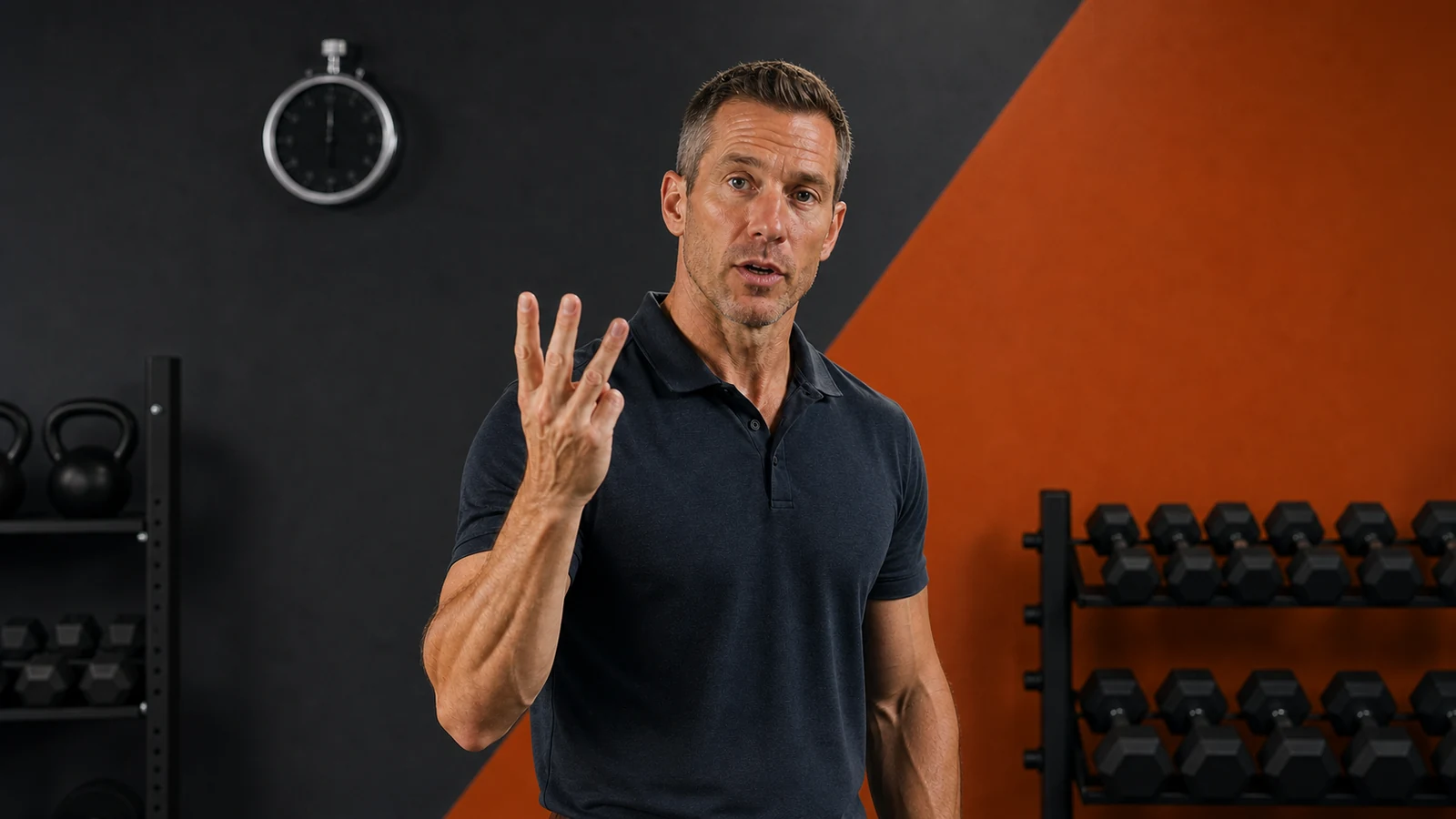

A viral video from exercise scientist Andy Galpin claims there are three simple rules for building muscle, gaining strength, and staying healthy for the long run.
Galpin is a real PhD researcher who studies human performance and skeletal muscle.
That gives his claims more weight than the average fitness influencer.
But even a credentialed scientist’s talking points deserve a check against the actual published literature, not just a nod because of the name attached.
So we pulled the peer-reviewed research behind the three ideas at the center of the video: progressive overload, training volume, and the link between strength training and a longer, healthier life.
What the Video Claims
The video argues that progressive overload is the master key to building muscle and strength over time.
It also claims that weekly training volume, meaning how many hard sets you do for each muscle group, is one of the biggest drivers of muscle growth.
Finally, it frames resistance training as one of the most important things a person can do for long-term health, not just for looking good.
Those are three separate claims, and each one has its own body of research behind it.
Let’s take them one at a time.
What the Research Actually Shows About Progressive Overload
Progressive overload means gradually asking your muscles to do more over time.
That can mean more weight, more reps, more sets, or better technique on the same lift.
The idea itself is not new, and it is not controversial among exercise scientists.
A large review in the Journal of Strength and Conditioning Research laid out the mechanisms behind muscle growth in detail (Schoenfeld, 2010).
That review described how mechanical tension, the stress placed on muscle fibers under a growing load, is one of the primary drivers of hypertrophy.
In plain language, your muscles need a reason to grow.
Lifting the exact same weight for the exact same reps, week after week, does not give them that reason.
Your muscles do not grow because you showed up. They grow because you asked them for something they were not ready to do yet.
That said, progressive overload is a principle, not a precise formula.
The research does not hand you an exact number of pounds to add each week.
It tells you the direction to move in, not the exact map.
How Much Training Volume You Actually Need
The video also leans on the idea that weekly volume drives muscle growth.
This one has been tested directly.
A 2017 systematic review and meta-analysis pooled data from multiple resistance training studies to look at the relationship between weekly sets and muscle growth (Schoenfeld, Ogborn, and Krieger, 2017).
The researchers found a graded, dose-response pattern.
More weekly sets per muscle group were linked to more muscle growth, up to a point.
Their analysis suggested that performing around 10 or more hard sets per muscle group each week produced noticeably better hypertrophy results than doing fewer than 5.
That does not mean 10 sets is a hard requirement for everyone.
It means the general trend, more quality volume within reason, tends to help.
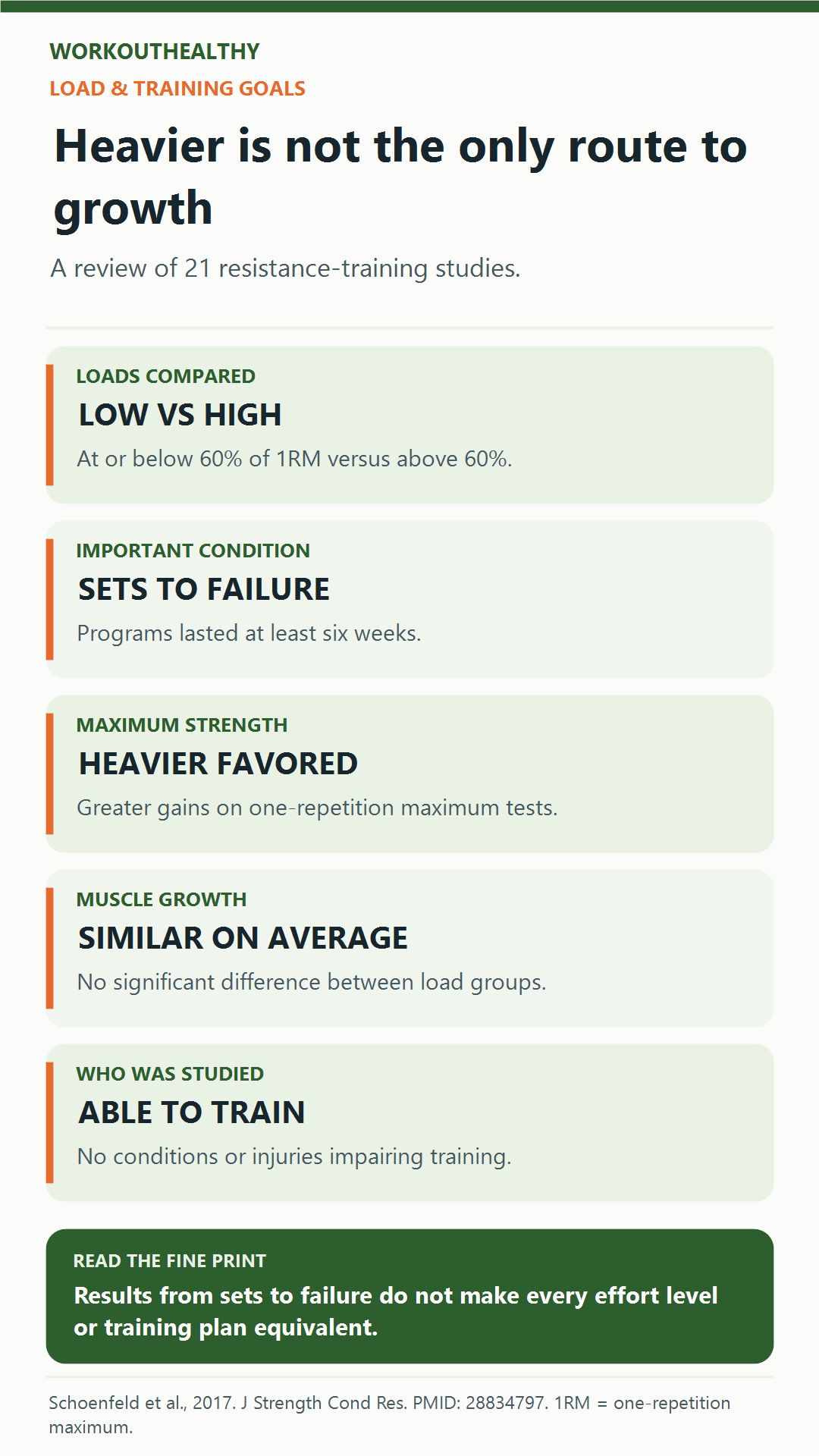
A separate meta-analysis looked at a related question: does the amount of weight on the bar matter as much as people think (Schoenfeld, Grgic, Ogborn, and Krieger, 2017)?
That review compared low-load training, using lighter weights for higher reps, against high-load training with heavier weights and fewer reps.
When both approaches were taken close to muscular failure, the researchers found similar hypertrophy outcomes between the two loading styles.
Strength gains, though, tended to favor the heavier loads.
This matters for anyone comparing a floor press against a bench press or debating which version of a lift to build a program around.
The exact exercise selection may matter less than whether the set is taken hard enough, and often enough, over time.
Why This Actually Works: The Mechanism Behind It
It helps to understand why volume and overload matter at the cellular level.
When a muscle fiber is placed under enough mechanical tension, it triggers a cascade of signals inside the cell (Schoenfeld, 2010).
Those signals turn on muscle protein synthesis, the process your body uses to repair and build new muscle tissue.
Metabolic stress, the burning feeling near the end of a hard set, appears to play a supporting role too.
Muscle damage from a workout was once thought to be the main trigger for growth.
More recent research suggests it plays a smaller role than mechanical tension does.
None of these mechanisms work in isolation from recovery.
Muscle is actually built during rest, not during the workout itself.
That is part of why chronically skipping sleep or under-eating can blunt gains, even when the training itself is well designed.
The Longevity Piece: What Strength Training Does for Long-Term Health
The video’s boldest claim may be the one about longevity.
Here, the evidence is genuinely strong, and it comes from a different kind of study entirely.
A 2022 systematic review and meta-analysis of cohort studies looked at muscle-strengthening activities and their relationship to death from any cause, plus specific diseases (Momma, Kawakami, Honda, and Sawada, 2022).
The researchers pooled data across a large number of adults tracked over years.
They found that people who did muscle-strengthening activities had a lower risk of dying from any cause during the study periods, compared to people who did none.
The same review found lower risk for cardiovascular disease, diabetes, and total cancer among people who strength trained.
Interestingly, the benefit did not just keep climbing the more someone trained.
The researchers described something closer to a J-shaped pattern, where the biggest drop in risk showed up at a moderate weekly amount, roughly 30 to 60 minutes per week.
You do not need to live in the gym to get the longevity benefit. You need to show up consistently, for a modest amount of time each week.
This lines up with a broader pattern seen in other movement research too.
Studies on daily step counts and mortality risk have found something similar: benefits that show up well before extreme volumes are reached.
Consistency at a reasonable dose seems to matter more than pushing to an extreme.
For readers who have watched the ongoing debate between weightlifting and cardio-style training, this research adds another point in favor of including resistance work, not replacing cardio with it entirely.
What This Evidence Does Not Prove
It’s worth being honest about the limits here.
The mortality research is observational, meaning it tracks people’s habits and outcomes without randomly assigning who lifts weights and who does not.
That kind of study can show a strong association.
It cannot prove, on its own, that lifting weights directly causes a longer life.
People who strength train may also sleep better, eat differently, or have other advantages that researchers cannot fully separate out.
The volume and load studies have their own limits too.
Most were done on relatively young, healthy, trained or semi-trained adults.
The “10 sets” figure is an average finding across many people, not a guarantee for any one individual.
Genetics, training age, sleep, stress, and nutrition all change how a given person responds to the exact same program.
Andy Galpin’s video simplifies these findings into three clean rules, which is useful for a short video.
The underlying science is messier, and more conditional, than any short clip can fully capture.
Common Mistakes People Make With This Information
The most common mistake is treating progressive overload as “always add weight.”
Adding reps, adding a set, slowing down the lowering phase, or simply improving your form all count as overload too.
A second common mistake is chasing volume without matching recovery.
Jumping from 5 weekly sets per muscle group to 20 sets overnight is a common way people get hurt or burn out.
A third mistake is ignoring the load research and assuming heavy weight is the only path to muscle growth.
The evidence suggests lighter loads, taken close to failure, can build similar amounts of muscle.
This matters for anyone recovering from an injury or working around joint pain who still wants to build size.
A fourth mistake is applying the longevity research as an excuse to do the bare minimum forever.
The 30 to 60 minute weekly range in the mortality research is a floor worth hitting, not necessarily a ceiling to stop at if your goals include real strength or muscle gain.
Someone focused on maintaining muscle as they age might also look at how unwanted weight loss can come with muscle loss, since strength training is one of the more direct tools for protecting muscle during that process.
Who Should Check With a Doctor First
Most healthy adults can start a sensible resistance training program without special clearance.
That said, some situations call for a conversation with a doctor or physical therapist first.
Anyone with uncontrolled high blood pressure should get guidance before lifting near failure.
Anyone recovering from a recent surgery, especially joint replacement or spinal surgery, needs a cleared timeline before adding load.
People with a heart condition, including arrhythmias or a history of cardiac events, should also check in first.
Anyone new to exercise after a long period of inactivity should ease in gradually, ideally with some professional guidance early on.
Pregnant individuals should get personalized guidance, since safe volume and intensity can shift throughout pregnancy.
None of this means resistance training is risky for most people.
It means the “how much and how hard” question is personal, and a professional can help answer it safely.
A Practical Way to Apply This
Start with a program that hits each major muscle group at least twice a week.
Aim for somewhere in the range of 10 to 20 hard sets per muscle group weekly, adjusting based on how you recover.
Beginners should start at the lower end of that range and build up over months, not weeks.
Pick a rep range you can stick with consistently, whether that’s 5 reps or 15.
The load research suggests the exact number matters less than effort and consistency.
Track your workouts, even with a simple notebook or phone app.

You cannot apply progressive overload if you do not remember what you lifted last time.
Add small amounts of overload every week or two, not every single session.
That might mean one more rep, five more pounds, or one more set on a single exercise.
Protect your recovery with sleep and adequate protein intake, since that is when the actual muscle building happens.
For the longevity angle, treat 30 to 60 minutes of weekly strength work as a genuine floor, not an aspirational goal.
If you’re new to structured programs, comparing simple, well-studied movements is a reasonable place to start, the kind of comparison you’ll see in guides like this one on choosing between a floor press and a bench press.
Reassess your program every 8 to 12 weeks and adjust based on real progress, not guesswork.
Watch the Original Video
Want more like this? Subscribe to WorkoutHealthy Insider for practical explanations behind popular fitness claims.
References
Schoenfeld, B. J. (2010). The mechanisms of muscle hypertrophy and their application to resistance training. Journal of Strength and Conditioning Research, 24(10), 2857 to 2872. https://doi.org/10.1519/JSC.0b013e3181e840f3
Schoenfeld, B. J., Ogborn, D., & Krieger, J. W. (2017). Dose-response relationship between weekly resistance training volume and increases in muscle mass: A systematic review and meta-analysis. Journal of Sports Sciences, 35(11), 1073 to 1082. https://doi.org/10.1080/02640414.2016.1210197
Schoenfeld, B. J., Grgic, J., Ogborn, D., & Krieger, J. W. (2017). Strength and hypertrophy adaptations between low- vs. high-load resistance training: A systematic review and meta-analysis. Journal of Strength and Conditioning Research, 31(12), 3508 to 3523. https://doi.org/10.1519/JSC.0000000000002200
Momma, H., Kawakami, R., Honda, T., & Sawada, S. S. (2022). Muscle-strengthening activities are associated with lower risk and mortality in major non-communicable diseases: A systematic review and meta-analysis of cohort studies. British Journal of Sports Medicine, 56(13), 755 to 763. https://doi.org/10.1136/bjsports-2021-105061
This article is for general information only and is not medical advice. If you have an injury, ongoing pain, or a medical condition, talk to a doctor or physical therapist before you change how you train or eat.