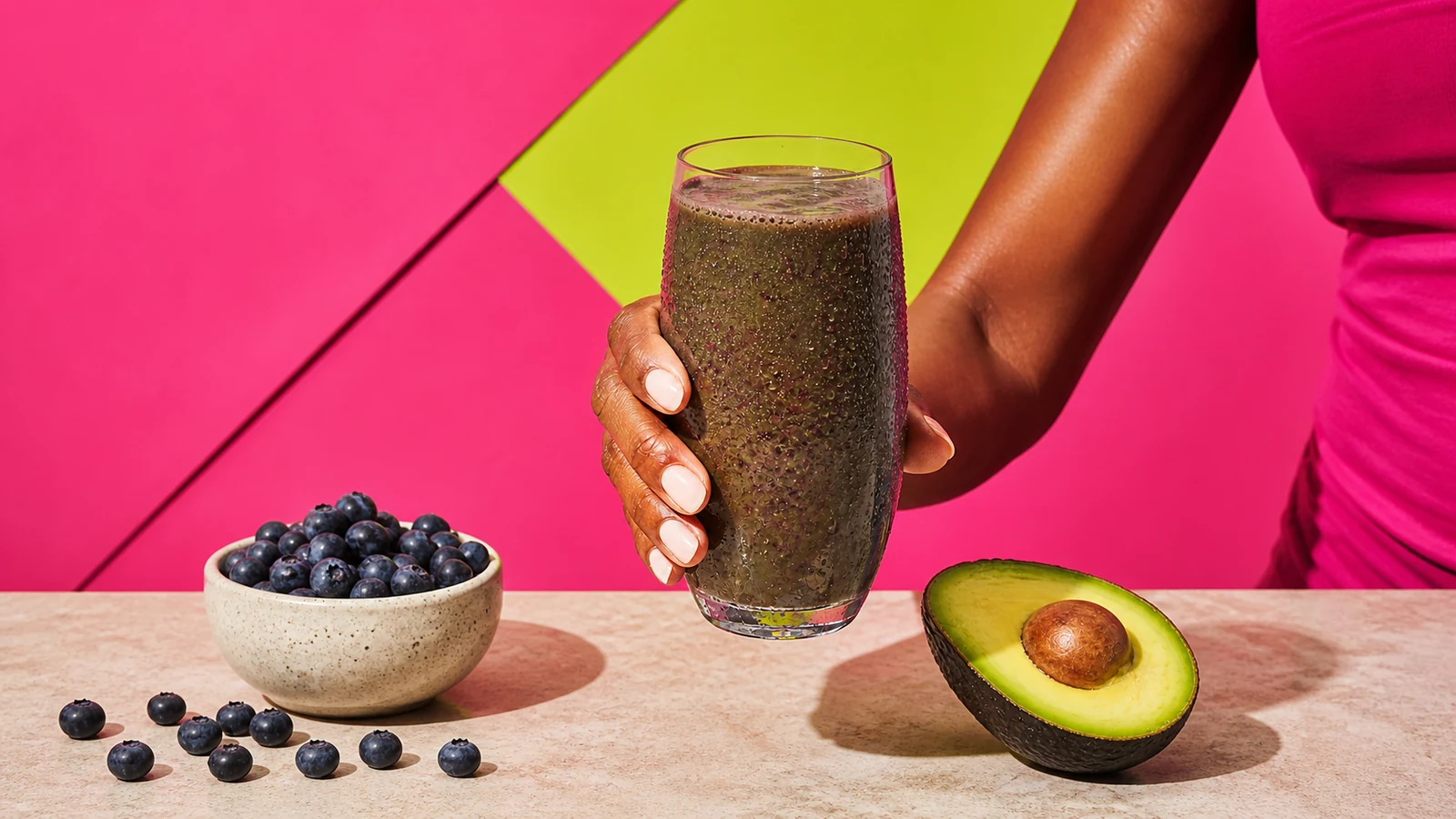

A Smoothie Habit at 73
She is 73 years old.
Every morning, before she does anything else, she blends the same drink.
A YouTube channel called Ageless Fitness Lifestyle posted her routine, and it reached far more people than a typical morning vlog.
The video is called “The Healthy Aging Smoothie I Drink at 73.”
It shows a simple recipe built around berries, a scoop of protein powder, a handful of leafy greens, and a few extras she says help her feel steady as she gets older.
Viewers wanted to know if one daily drink could really do all of that.
So we set the video aside for a moment and looked at the actual nutrition research behind each ingredient she uses.
Does a single smoothie really change how a person ages, or is the real answer more complicated than that?
What the Video Actually Claims
In the video, the woman walks through her blender routine step by step.
She credits the smoothie with keeping her energy steady, supporting regular digestion, and backing what she calls healthy aging in general.
She names berries for their antioxidants.
She names a scoop of protein powder for her muscles.
She names spinach or kale for nutrients she connects to a sharp memory.
She also adds a spoonful of ground flaxseed or nut butter for healthy fat, and says the fiber in the drink keeps her full until lunch.
Nowhere in the video does she cite a specific study, and that detail matters.
Her claims come from personal experience and general nutrition knowledge, not from a clinical trial she conducted herself.
That does not automatically make her routine wrong.
It just means her claims deserve the same fact check that any health claim on social media deserves.
What the Research Actually Supports
This is the part where the video’s ingredient list holds up reasonably well, once you look for the evidence behind each piece.
Start with the berries.
Berries are rich in plant compounds called polyphenols, which act as antioxidants once inside the body.
Antioxidants help neutralize unstable molecules called free radicals, which build up over time and are linked to the slow wear and tear behind many aspects of aging.
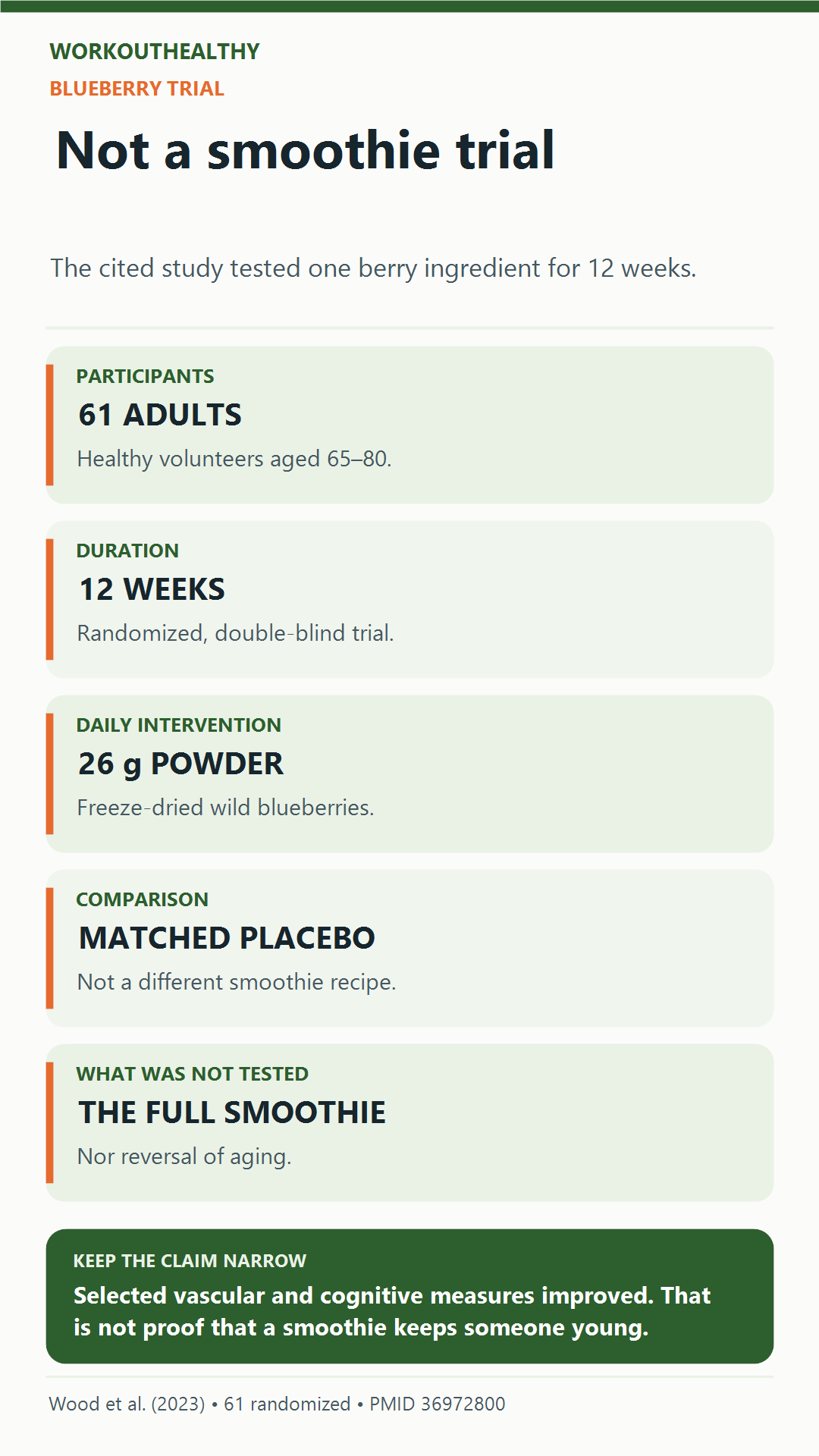
A randomized controlled trial published in The American Journal of Clinical Nutrition gave healthy older adults a wild blueberry polyphenol drink and compared them with a matched placebo group (Wood et al., 2023).
The blueberry group showed better blood vessel function and performed better on certain memory tests than the placebo group.
That is a real, verified result, and it lines up with what the video says about berries supporting healthy aging.
Next is the protein powder.
As people age, they naturally lose muscle mass and strength, a condition researchers call sarcopenia.
Sarcopenia is not just a cosmetic issue.
It raises the risk of falls, makes everyday tasks like climbing stairs harder, and is one of the biggest threats to living independently later in life.
A systematic review and meta-analysis pooled data from many studies on older adults and found that higher dietary protein intake was linked to a lower likelihood of sarcopenia (Coelho-Junior et al., 2022).
A scoop of protein powder is one simple way to raise a smoothie’s protein content without adding a large amount of food volume, which matters for older adults with a smaller appetite.
This connects directly to why muscle loss deserves its own attention, something we cover in more depth in our look at why people lose weight and muscle mass as they age.
Then there are the leafy greens.
A large, long running study followed older adults for years and tracked how much leafy green vegetables like spinach and kale they ate (Morris et al., 2018).
The people who ate about one to two servings of leafy greens a day showed a slower rate of cognitive decline, equal to roughly 11 fewer years of brain aging, compared with people who rarely ate them.
That is one of the more striking findings in aging nutrition research, and it directly supports the video’s claim about greens and a sharp mind.
Cognitive health and physical training are closely linked too, which is worth exploring further in our review of what the research shows about lifting weights and brain health.
Fiber also has real research behind it.
A large cohort study tracked adults for years and compared people with the highest fiber intake to those with the lowest (Park et al., 2011).
People with the highest fiber intake had a meaningfully lower risk of death during the study period, even after the researchers adjusted for other health habits.
Fiber is thought to help in more than one way.
It feeds beneficial gut bacteria, slows down how quickly sugar enters the bloodstream, and helps the digestive system move waste through the body on a regular schedule.
Healthy fats, like the flaxseed or nut butter mentioned in the video, are generally recommended in dietary guidelines because they help the body absorb certain vitamins and support healthy cells.
That claim is well supported by general nutrition science, even though it is not tied to one single standout study the way the berries or greens are.
No single smoothie recipe has been tested as a complete treatment for aging. What the research actually supports is the value of specific ingredients inside a varied diet, not a miracle in a glass.
What This Evidence Does Not Prove
None of the studies above tested this exact smoothie recipe.
Each one tested a single ingredient or nutrient on its own, usually in a controlled amount that a home blender cannot exactly replicate.
Blending berries, protein powder, greens, and fat together does not automatically add up to the same benefit as four separate studies stacked on top of each other.
The fiber and mortality study, in particular, is observational, which means it shows a link, not proof that fiber alone caused people to live longer.
People who eat more fiber often also exercise more, smoke less, and see a doctor more regularly, and those habits could explain part of the result.
Individual results also vary a great deal based on genetics, existing health conditions, sleep, stress, and the rest of a person’s diet.
A smoothie is one small piece of a much bigger picture, not a shortcut around it.
The amount of protein powder or blueberry extract used in a research trial is also often more concentrated and more carefully measured than what most people scoop into a home blender.
Anyone expecting one drink to reverse or prevent aging on its own is setting up for disappointment.
Common Mistakes People Make With Healthy Aging Smoothies
The most common mistake is too much fruit and not enough of anything else.
A smoothie loaded with three or four servings of fruit can quietly deliver as much sugar as a soda, even though it feels healthy.
The second mistake is skipping protein entirely.
A fruit and greens smoothie with no protein source does very little for the muscle loss concerns older adults actually care about.
The third mistake is treating the smoothie as a full meal replacement.
A typical smoothie, even a good one, usually falls short of the calories and variety a real meal provides.
Using it as a snack or an addition to breakfast works far better than using it as breakfast’s entire content.
The fourth mistake is assuming more ingredients always means more benefit.
Piling in five or six extras can water down portion sizes of the ingredients that actually matter, like the protein and the greens.
A fifth mistake is adding sweeteners on top of naturally sweet fruit, such as honey, flavored yogurt, or juice instead of water or milk.
Those extras quietly turn a nutrient dense drink into a dessert, without adding any real benefit for healthy aging.
Who Should Check With a Doctor or Dietitian First
People managing diabetes or blood sugar issues should pay close attention to the fruit portion of any smoothie.
Blended fruit raises blood sugar faster than whole fruit does, since blending breaks down much of the fiber structure that slows digestion.
People with kidney disease need individual guidance too.
Extra protein and high potassium ingredients, like bananas or large amounts of leafy greens, can be a problem for a kidney that is already under strain.
People taking blood thinning medication, such as warfarin, should talk to their doctor about leafy greens specifically.
Spinach and kale are rich in vitamin K, and sudden changes in vitamin K intake can interfere with how well a blood thinner works. Consistency, and a conversation with a doctor, matters more than the amount in any single smoothie.
Anyone with a swallowing disorder, a diagnosed food allergy, or a restricted diet for another medical reason should also get individualized advice before adding a new daily smoothie habit.
A registered dietitian can help fit a smoothie into an existing care plan instead of working against it.
Older adults are also more likely to take multiple prescription medications at once, and new food habits can sometimes interact with those medications in ways that are easy to miss without professional input.
A Simple Template for a Balanced Aging Smoothie
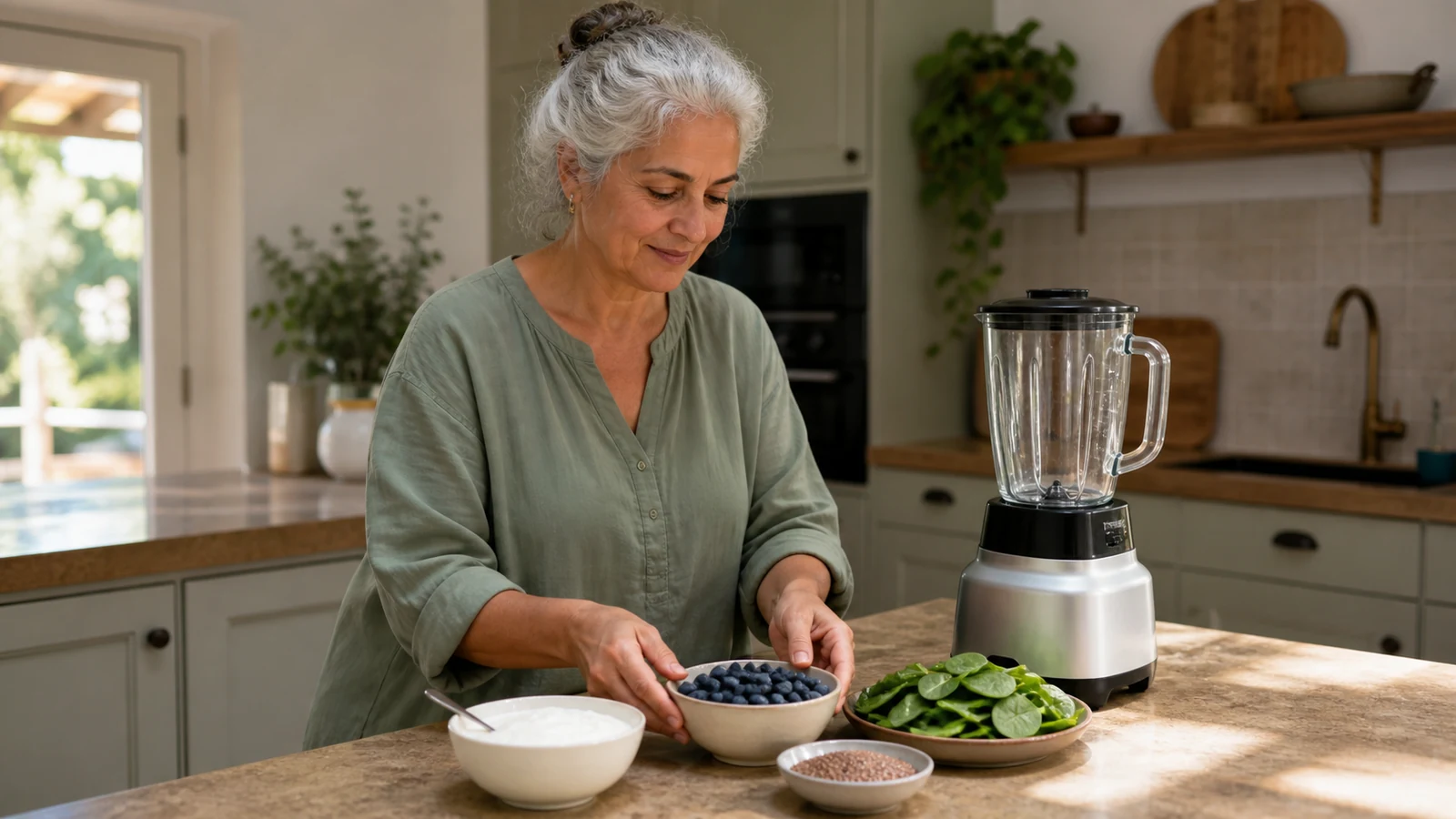
A useful way to think about a smoothie is as a template rather than a fixed recipe.
Start with a liquid base, like milk, a fortified plant milk, or plain water.
Add one serving of berries or another fruit for natural sweetness and antioxidants.
Add a real protein source, such as a scoop of whey or plant protein powder, plain yogurt, or cottage cheese.
Add a handful of spinach or kale, which blends in with very little taste change.
Add one source of healthy fat, like a tablespoon of ground flaxseed, chia seeds, or nut butter.
That combination covers protein, fiber, antioxidants, and healthy fat in one glass, without relying on any single ingredient to do all the work.
Keeping the fruit to about one cup and the added liquid modest also keeps the calorie count and sugar content reasonable for a daily habit rather than an occasional treat.
Pairing that habit with regular movement matters just as much, and something as simple as a daily walking goal is a reasonable place to start, a topic covered in our guide to how many miles you should walk a day.
Watch the Original Video
Want more like this? Subscribe to WorkoutHealthy Insider for practical explanations behind popular fitness claims.
References
Coelho-Junior, H. J., Calvani, R., Azzolino, D., Picca, A., Tosato, M., Landi, F., Cesari, M., & Marzetti, E. (2022). Protein intake and sarcopenia in older adults: A systematic review and meta-analysis. International Journal of Environmental Research and Public Health, 19(14), Article 8718. https://doi.org/10.3390/ijerph19148718
Morris, M. C., Wang, Y., Barnes, L. L., Bennett, D. A., Dawson-Hughes, B., & Booth, S. L. (2018). Nutrients and bioactives in green leafy vegetables and cognitive decline. Neurology, 90(3), e214 to e222. https://doi.org/10.1212/WNL.0000000000004815
Park, Y., Subar, A. F., Hollenbeck, A., & Schatzkin, A. (2011). Dietary fiber intake and mortality in the NIH AARP diet and health study. Archives of Internal Medicine, 171(12), 1061 to 1068. https://doi.org/10.1001/archinternmed.2011.18
Wood, E., Hein, S., Mesnage, R., Fernandes, F., Abhayaratne, N., Xu, Y., Zhang, Z., Bell, L., Williams, C., & Rodriguez-Mateos, A. (2023). Wild blueberry (poly)phenols can improve vascular function and cognitive performance in healthy older individuals: A double-blind randomized controlled trial. The American Journal of Clinical Nutrition, 117(6), 1306 to 1319. https://doi.org/10.1016/j.ajcnut.2023.03.017
This article is for general information only and is not medical advice. If you have an injury, ongoing pain, or a medical condition, talk to a doctor or physical therapist before you change how you train or eat.