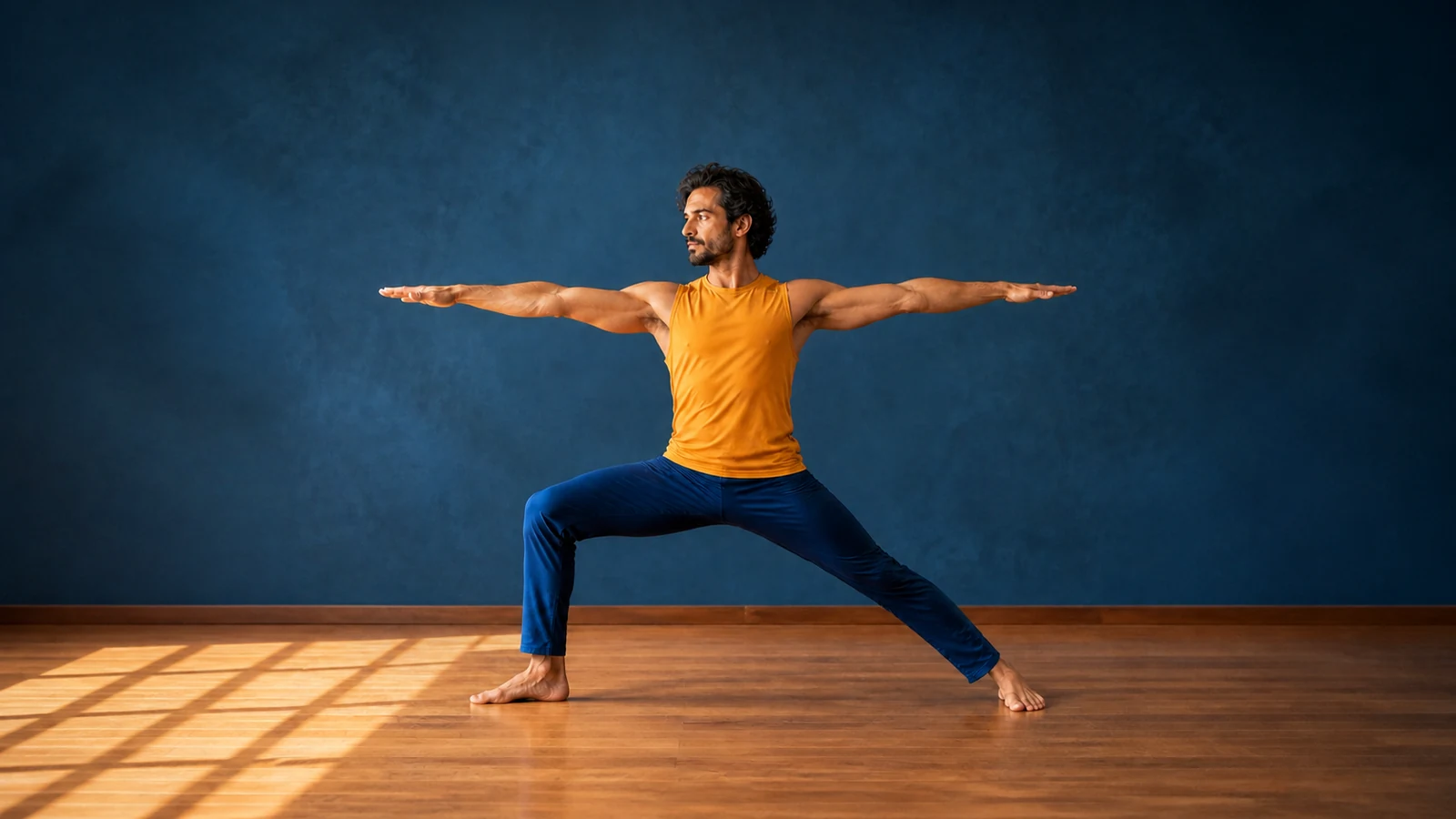

A 20 minute, no equipment yoga routine claims to support healthy blood pressure by combining light movement, isometric holds, and breathing exercises.
That combination isn’t just a nice idea.
It lines up with a growing body of research on yoga and blood pressure, and on two of the routine’s pieces individually.
What the Routine Includes
The sequence opens with easy movement, walking in place, side steps, and gentle body swings, to warm up the joints and get blood flowing.
From there it moves into holds like a wall sit, a plank, and a bridge pose, then finishes with two breathing practices meant to calm the nervous system.
What the Research Actually Shows
A 2019 meta-analysis in Mayo Clinic Proceedings pooled data from 49 randomized controlled trials on yoga and blood pressure (Wu et al., 2019).
It found that yoga lowered both systolic and diastolic blood pressure compared to no intervention, and lowered systolic blood pressure compared to other forms of exercise as well.
The researchers also found that yoga programs combining multiple elements, postures, breathing, and relaxation together, tended to produce larger blood pressure reductions than postures alone.
That matches the structure of this particular routine, which deliberately blends holds with breathing rather than doing just one or the other.
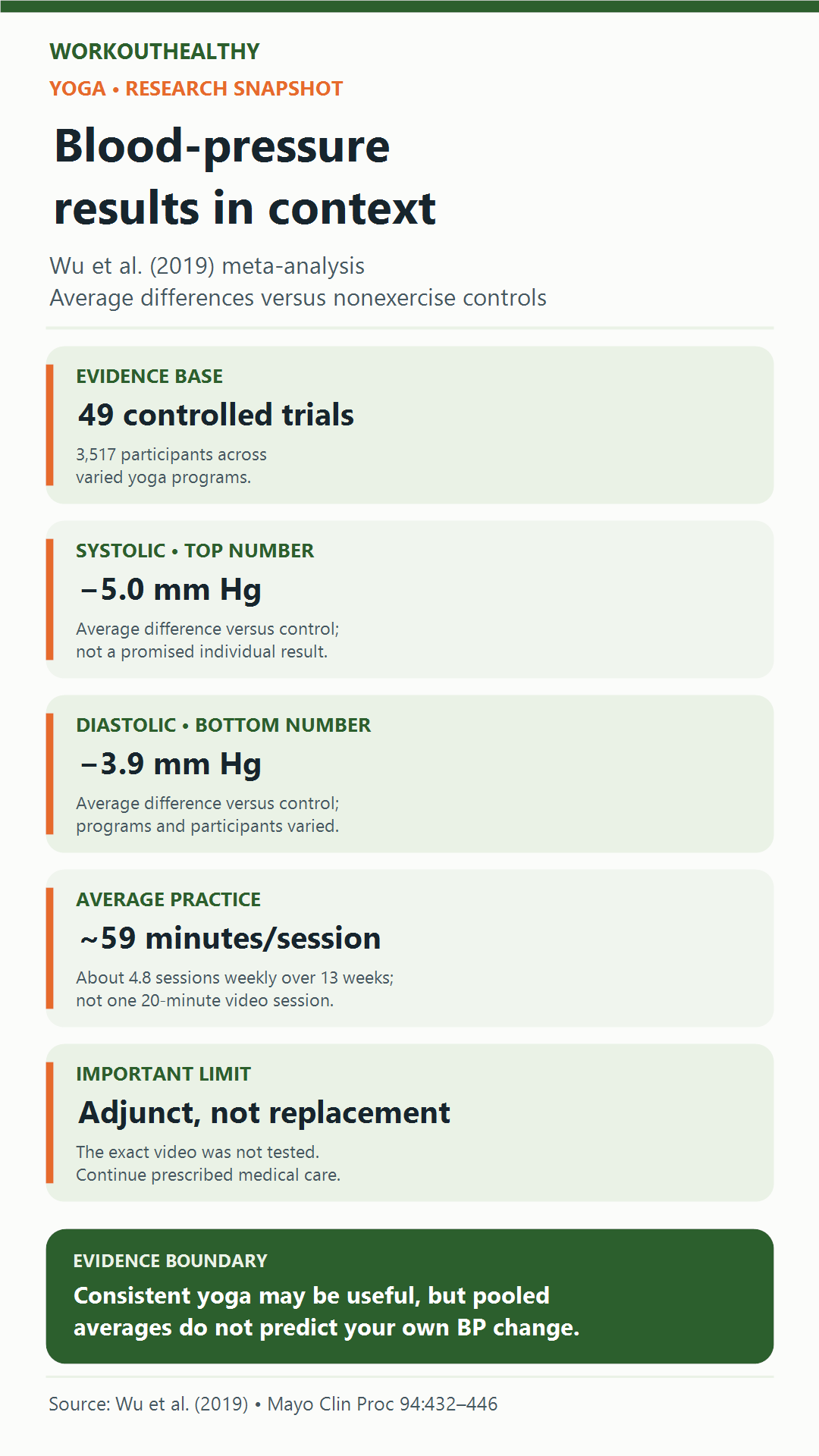
Yoga that combines movement, holds, and breathing together tends to lower blood pressure more than any one piece on its own.
The Mechanism: Why Slow Breathing and Muscle Holds Change Blood Pressure
Combined yoga programs pull on two separate systems in the body, and that may be part of why they beat postures alone.
The breathing portion appears to work through something called the baroreflex.
This is the body’s built in system for sensing blood pressure moment to moment and adjusting heart rate to keep it steady.
In a study published in the journal Hypertension, people with essential hypertension breathed at a slow, controlled pace of about 6 breaths a minute for a single session (Joseph et al., 2005).
Afterward, their baroreflex sensitivity nearly doubled, and their average blood pressure dropped from about 149.7 over 82.7 to about 141.1 over 77.8.
Slow breathing appears to retrain a reflex that high blood pressure tends to blunt.
The isometric holds seem to work through a different pathway.
Holding a muscle contraction, like a wall sit, briefly reduces blood flow into that muscle.
When the hold ends, blood rushes back in.
Researchers studying isometric exercise believe this repeated pattern, reduced flow followed by a rush of blood, is a stimulus that makes blood vessels more flexible over time, which lowers resting blood pressure (Carlson et al., 2014).
The same body of research also points to changes in how the nervous system regulates blood pressure at rest.
Put together, a routine that pairs breathing with holds is putting pressure on two separate systems that each have their own reason to respond.
That’s a different strategy than a routine built entirely around stretching, which mostly targets muscle and joint flexibility rather than the nervous system or blood vessels directly.
It’s a reasonable explanation for why the combined approach shows up as more effective in the research than any single piece tested alone.
Why the Isometric Holds Matter
The wall sit, plank, and bridge in this routine are all isometric exercises, meaning the muscle contracts without the joint moving.
Isometric exercise on its own has separately been shown to lower resting blood pressure, so combining it with the breathing and movement portions of a yoga routine may be stacking more than one proven tool into a single session.
A 2014 meta-analysis in Mayo Clinic Proceedings pooled 9 randomized controlled trials on isometric exercise training and blood pressure (Carlson et al., 2014).
It found average reductions of about 6.8 points in systolic blood pressure and about 4 points in diastolic blood pressure, drops the authors described as larger than what is typically seen from aerobic or traditional resistance training.
It’s worth being precise about what that study actually tested.
Most of the trials used handgrip squeezes, not wall sits or planks, and the biggest benefit showed up with a specific protocol: four 2 minute holds, three times a week, at a moderate effort, sustained for at least 8 weeks.
A single wall sit inside a 20 minute yoga flow is a different exercise from a dedicated 8 week handgrip program.
It’s reasonable to expect some benefit from the isometric portion of this routine, without assuming it will match those exact numbers.
What This Evidence Doesn’t Prove
The Wu et al. (2019) meta-analysis is strong evidence that yoga, done consistently, is linked to lower blood pressure.
It does not prove that any single 20 minute video will produce those results for any one person.
Meta-analyses like this one pool many different studies, with different yoga styles, different session lengths, and different populations.
Some trial participants had diagnosed hypertension, others didn’t.
That mix makes it hard to say exactly how much of an effect a healthy person doing this specific routine should expect.
It’s also hard to run a truly blinded trial on yoga.
Participants know whether they are doing yoga or sitting in a waiting room, and that awareness alone can change how people report feeling, even if it can’t change a blood pressure cuff reading on its own.
Most of the included trials also ran for a matter of weeks or a few months, so the research says less about what happens after years of regular practice.
None of this means the research is weak.
It means yoga looks like a genuinely useful piece of a blood pressure plan, not a replacement for medication or medical care once blood pressure is already high.
The research also doesn’t spell out a minimum effective dose.
Whether 3 sessions a week works as well as 7, or whether 10 minutes gets most of the benefit of 20, hasn’t been nailed down.
Until it is, more consistent practice is the safer assumption than trying to find the smallest amount that still counts.
Common Mistakes That Blunt the Benefit
Holding your breath during a wall sit or plank is the most common mistake.
Straining against a held breath, called the Valsalva maneuver, spikes blood pressure sharply while it’s happening.
The whole point of pairing holds with breathing is to avoid this, so breathing steadily through each hold matters more than how long the hold lasts.
Rushing the breathing segments is another common mistake. Slow breathing that actually shifts the baroreflex takes patience.
A rushed, shallow version of “deep breathing” done for 30 seconds before moving on doesn’t give the nervous system enough time to respond.
Doing the routine inconsistently is the last one.
The research behind these numbers comes from programs that ran for many weeks with regular sessions.
A routine done once and then forgotten for a month isn’t the same intervention the studies actually tested.
The breathing and the holds are not two separate add ons. They are two different levers on the same system, and the research suggests pulling both works better than pulling just one.
Who Should Check With a Doctor First
Anyone with uncontrolled high blood pressure, diagnosed heart disease, dizziness, chest pain, or another cardiovascular condition should talk to a doctor before starting a routine like this one.
A few other groups deserve a specific mention.
Isometric holds and breath control can briefly raise pressure inside the eye and skull, so people with glaucoma or a history of retinal problems should ask an eye doctor first.
Pregnant women should check with their doctor before starting any new isometric or breath focused routine.
Anyone who has recently had surgery, or who gets lightheaded when standing up quickly, should be cautious with holds that involve dropping the head or coming out of a pose fast.
How to Do the Routine Correctly: A Step by Step Guide
Start with the warm up every time, even on days when you feel like skipping straight to the holds.
Two to three minutes of walking in place and gentle swings raises your heart rate gradually instead of shocking your system straight into an isometric hold.
For the wall sit, plank, and bridge, aim for a hold you can sustain with steady breathing, not one you have to grit your teeth through.
If you can’t breathe normally, ease up on the position slightly.
A rough starting target is 20 to 30 seconds per hold, working up to 45 to 60 seconds over a few weeks as it gets easier.
Breathe in through your nose and out through your nose or mouth during every hold.
Try to make your exhale slightly longer than your inhale.
That pattern nudges you toward the slow breathing rate used in the blood pressure research, without needing to count breaths per minute while you’re also holding a plank.
For the dedicated breathing segments at the end, sit or lie down comfortably and slow your breathing further, aiming for a long, smooth inhale and an even longer exhale.
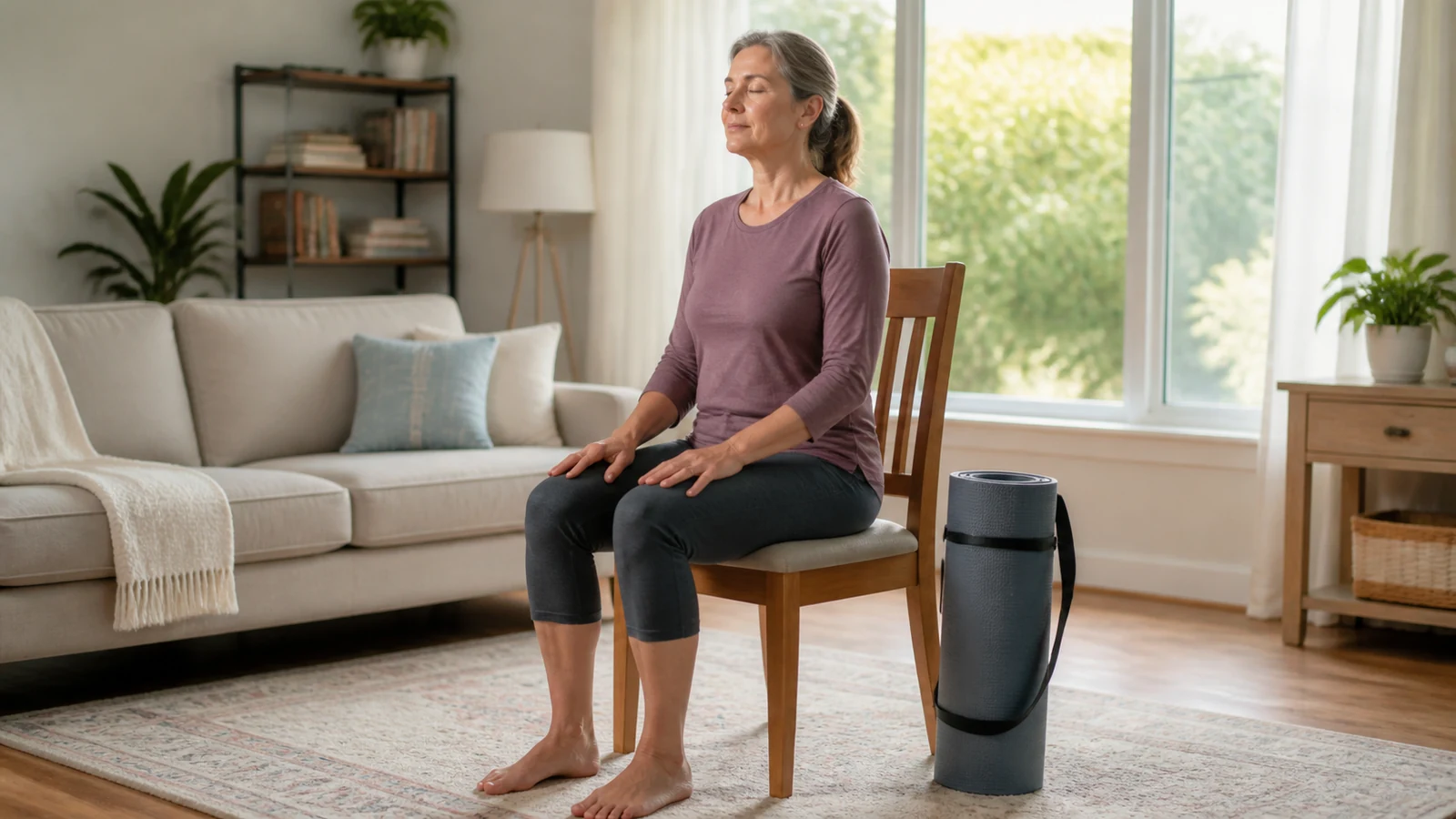
Somewhere around 5 to 6 full breaths a minute is the range used in the research on breathing and baroreflex sensitivity.
That’s slower than it sounds. Each full breath, in and out, takes about 10 seconds.
Progress the routine by adding a few seconds to each hold every week or two, not by adding new, harder positions.
The isometric benefit comes from consistent, moderate effort sustained over weeks, not from turning a wall sit into a maximum effort test.
You’re doing it right if you finish the 20 minutes feeling calmer than when you started, with muscles that worked but a breathing pattern that stayed under control the whole time.
If you finish out of breath and tense, ease off the hold lengths next time and add the time back gradually.
If you already track your blood pressure at home, taking a reading before you start a consistent practice and again after several weeks can show you whether it’s making a measurable difference for you specifically, on top of whatever it feels like session to session.
For related reading, see our article on what the research says about sauna use and heart health, our piece on whether foot massage can really help you relax, and our guide to what daily step counts show about mortality risk.
Watch the Original Video
Get the next evidence check. Subscribe to WorkoutHealthy Insider for practical explanations behind popular fitness claims.
References
Carlson, D. J., Dieberg, G., Hess, N. C., Millar, P. J., & Smart, N. A. (2014). Isometric exercise training for blood pressure management: A systematic review and meta-analysis. Mayo Clinic Proceedings, 89(3), 327 to 334. https://doi.org/10.1016/j.mayocp.2013.10.030
Joseph, C. N., Porta, C., Casucci, G., Casiraghi, N., Maffeis, M., Rossi, M., & Bernardi, L. (2005). Slow breathing improves arterial baroreflex sensitivity and decreases blood pressure in essential hypertension. Hypertension, 46(4), 714 to 718. https://doi.org/10.1161/01.HYP.0000179581.68566.7D
Wu, Y., Johnson, B. T., Acabchuk, R. L., Chen, S., Lewis, H., Livingston, J., Park, C. L., & Pescatello, L. S. (2019). Yoga as antihypertensive lifestyle therapy: A systematic review and meta-analysis. Mayo Clinic Proceedings, 94(3), 432 to 446. https://doi.org/10.1016/j.mayocp.2018.09.023
This article is for general information only and is not medical advice. If you have an injury, ongoing pain, or a medical condition, talk to a doctor or physical therapist before you change how you train or eat.