
A morning vs evening workout has no universal winner for long-term results. Some tests show higher strength or power later in the day, but training studies have not established one clock time as best for everyone.
Choose a slot you can attend without cutting sleep, then judge it by your own completed sessions and training quality. Our readers’ 105-comment Facebook tally is useful audience context, not a population survey or an experiment on exercise results.
A clock time is useful only if the workout and the sleep around it still fit your life.
Morning vs evening workout: compare the outcome
| Question | What evidence can say | What to do |
|---|---|---|
| Will I perform better in one session? | Some strength and power tests favor later hours, but chronotype and test conditions matter. | Compare the same workout after a comparable warmup, meal, and sleep. |
| Will I gain more strength or endurance over months? | A 2023 review found little reliable evidence for one universally superior training time. | Pick a repeatable slot; if preparing for a timed event, practice near its expected start time when feasible. |
| Will evening exercise hurt sleep? | Evening exercise usually did not impair sleep in a 2019 review, but vigorous work ending very close to bedtime may be different. | Track sleep onset and quality; move or ease a late session if you notice a recurring problem. |
| Which time will I actually keep? | This depends on the person, schedule, commute, and sleep; our comment thread cannot establish a population advantage. | Compare completed sessions over several weeks instead of assuming mornings are more disciplined. |
One strong session is not the same as long-term gains
A single afternoon or evening strength test can be better than a morning test, and individual chronotype may shift that pattern. A study of time of day and chronotype illustrates why a fixed clock-time rule misses individual variation.
That does not mean that months of evening training will necessarily build more muscle or endurance. A 2023 systematic review included 26 articles covering 22 studies, with seven studies in its meta-analyses, and found little evidence for a generally superior training time.
The review did find some evidence that training and performance testing at the same time of day can align outcomes. It also noted high risk of bias in many studies, so this is a practical consideration for a scheduled event rather than a promise of extra gains.
Morning training may feel easier to protect from evening commitments, while a later session may feel stronger after meals and movement. Those are plausible personal scheduling differences, not proof that one time generally wins for adherence or biology.
Late sessions, sleep, and caffeine
There is no evidence-based rule that everyone must stop exercise at sunset. A 2019 review of 23 studies found that evening exercise generally did not worsen sleep in healthy participants, although vigorous exercise ending within about an hour of bedtime may impair some sleep measures.
Your own bedtime, workout intensity, and response matter more than the label “evening.” If a late session repeatedly delays sleep, try a gentler session, more time before bed, or another training slot.
Caffeine can be another variable in a late workout. Our caffeine and sleep guide separates stimulant timing from exercise timing so you can change one factor at a time.
A four-week schedule test you can actually use
If both slots are realistic, try two weeks with your planned sessions in the morning and two weeks in the evening. Keep the exercise type and number of planned sessions similar, and do not force a late workout that cuts necessary sleep.
| Record after each planned session | Why it matters |
|---|---|
| Completed, shortened, or missed | The schedule has to survive ordinary life. |
| Workout measure | Use the same load and reps, distance and pace, or effort rating where practical. |
| Sleep before and after | Note bedtime, wake time, and whether falling asleep felt unusually difficult. |
| Practical friction | Record childcare, commute, work conflict, crowding, or rushed meals. |
At the end, choose the slot with better attendance and acceptable sleep, then use performance as a tie-breaker. This personal comparison is a scheduling tool, not a controlled experiment or proof that timing caused every difference.
A reliable training partner may help when the main obstacle is showing up, regardless of time.
What 105 WorkoutHealthy comments said
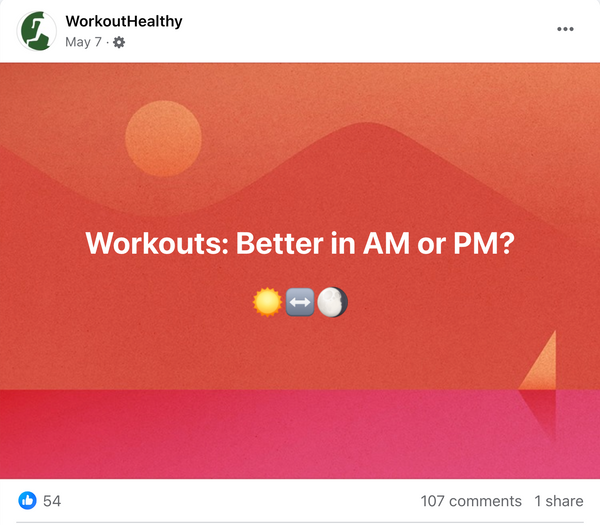
Our May 2024 Facebook post asked whether readers train in the morning or evening. The earlier article reported 66 morning, 15 evening, and 24 flexible or no-preference answers, totaling 105 comments.
| Previously reported category | Comments | Share of 105 |
|---|---|---|
| Morning | 66 | 63% rounded |
| Evening | 15 | 14% rounded |
| Flexible or no preference | 24 | 23% rounded |
The existing split chart is preserved as a display of that original tally, not a scientific estimate of what adults prefer. We could verify that the reported counts sum to 105, but we do not have a retained comment-by-comment coding sheet and could not independently recount every Facebook reply today.
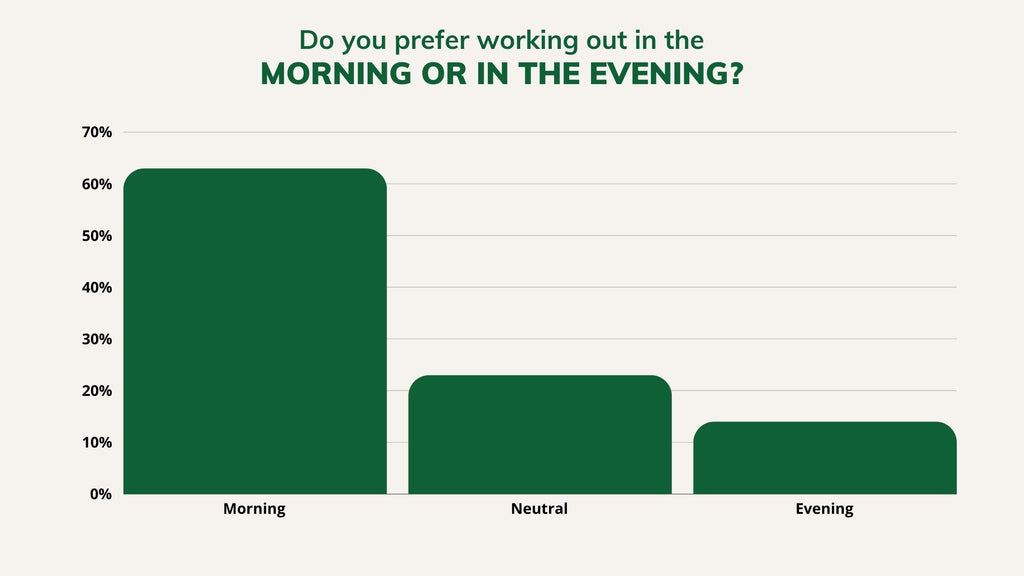
People who respond to a fitness page choose to participate, and the reasons in their comments are personal accounts. Their choices cannot establish that mornings improve adherence, that evenings improve every workout, or that either schedule is a medical intervention.
The bottom line
For most readers, the best training time is a repeatable slot that protects sleep and lets them complete useful work. Use the evidence to avoid overpromising, then test your own schedule with attendance, performance, and sleep together.
This article was first published on workouthealthy.com in October 2024, credited to Alexandra Carandang, and moved here in August 2026.
References
- Bruggisser and colleagues’ 2023 exercise-training time systematic review.
- Facer-Childs and colleagues’ 2018 chronotype and performance study.
- Stutz and colleagues’ 2019 evening exercise and sleep systematic review.
- Original WorkoutHealthy Facebook post.
Fitness note: This article offers general information, not a personal training or medical plan. If exercise affects an ongoing health or sleep condition, ask a qualified clinician for individual guidance.