

A video shows exercises for recovering after a stem cell hip treatment.
It comes from a business called Dream Body Clinic Stem Cells.
That name is not a research hospital or a university lab.
It is a commercial clinic that sells stem cell treatments to patients.
That matters before anyone looks at the exercises themselves.
Two separate questions sit inside this topic.
One question is whether stem cell therapy for hip problems actually works.
The other is whether rehab exercise after a hip procedure helps.
Those two questions have very different answers in the research.
Here is what the actual evidence says about each one.
What the Video Claims
The video’s title focuses on rehab exercises after a stem cell hip procedure.
It comes from Dream Body Clinic Stem Cells, a private clinic’s own channel.
It is patient education content made by the business selling the treatment.
It is not an independent medical source, a university, or a peer reviewed journal.
The channel does not name the specific stem cell product it uses.
It does not link to a published clinical trial behind its results.
Showing rehab exercises after a procedure is a reasonable thing to do.
But a company’s own video about its own treatment is marketing, not proof.
That distinction is the entire point of this article.
What Real Research Shows About Stem Cell Therapy for Hip Conditions
Start with the plainest fact first.
Stem cell therapy is not an FDA approved treatment for hip pain or hip osteoarthritis.
The FDA has said this directly about orthopedic conditions in general.
Regenerative medicine products for joints need FDA approval before they can be sold as treatments.
Almost none of the products clinics inject have gone through that approval process.
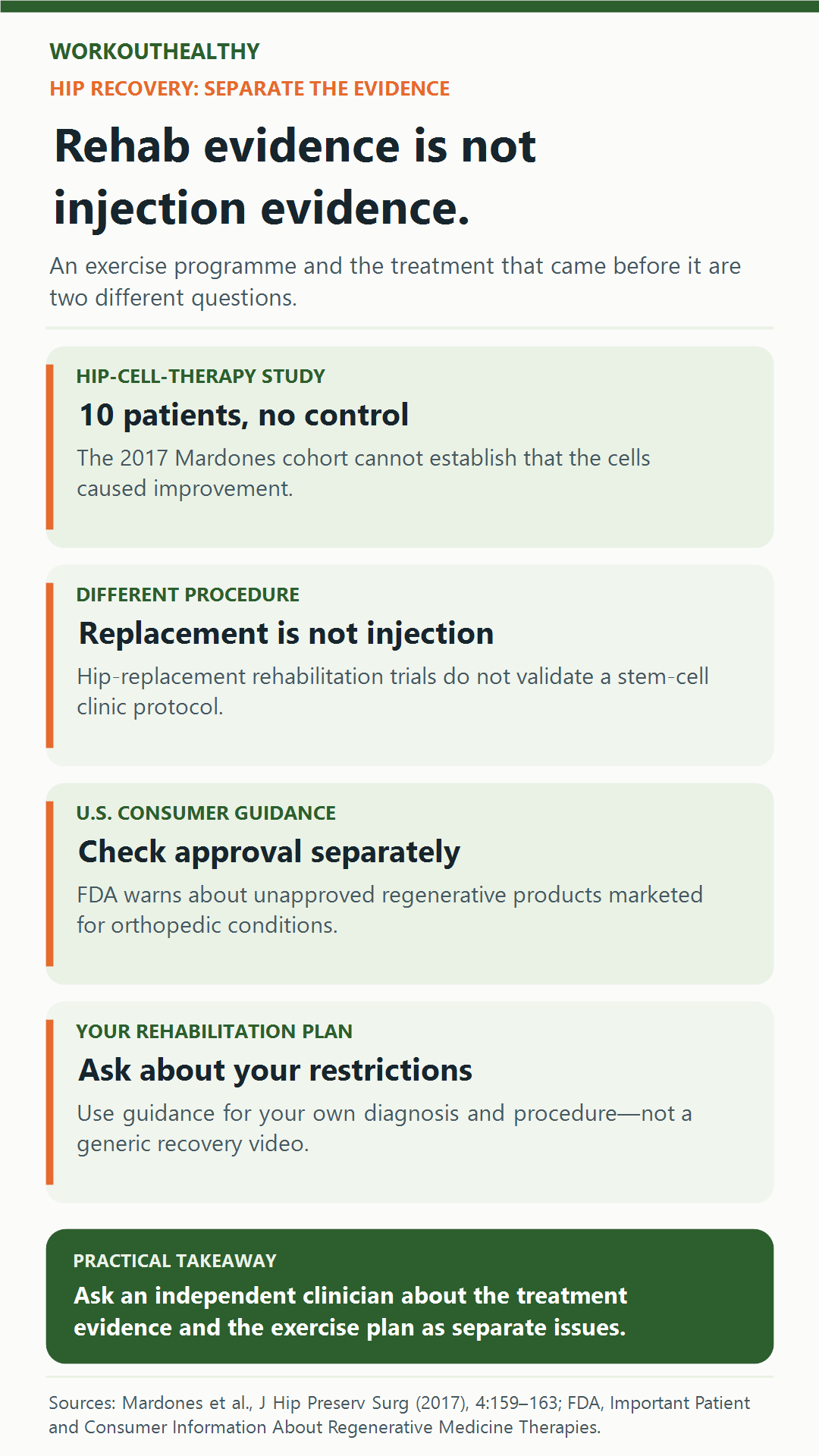
Regenerative medicine therapies have not been approved to treat any orthopedic condition, such as osteoarthritis, tendonitis, disc disease, tennis elbow, back pain, hip pain, knee pain, neck pain, or shoulder pain.
That quote comes from the FDA’s own consumer guidance on regenerative medicine (U.S. Food and Drug Administration, n.d.).
The same guidance warns that patients paying for these products outside a clinical trial may be “likely being deceived and offered a product illegally.”
That warning is aimed at the industry Dream Body Clinic Stem Cells operates in, not at this specific clinic by name.
None of this means no research exists on stem cells and hip osteoarthritis.
It means the research so far is small, early, and far from settled.
One published study followed a small group of hip osteoarthritis patients after a bone marrow derived stem cell injection (Mardones et al., 2017).
The researchers reported improved pain and function scores over the following months.
The study had no control group and only a small number of patients.
That kind of design cannot separate a real treatment effect from natural changes over time.
A larger review looked at stem cell injections for knee osteoarthritis instead, since that joint has more research behind it (Qu & Sun, 2021).
It pooled results from multiple randomized trials and found modest pain improvements.
The same review said plainly that larger, better designed trials are still needed.
Hip osteoarthritis has even less trial evidence behind it than the knee does.
None of this adds up to a proven, standard treatment.
It adds up to an experimental therapy that is still being studied.
What Real Research Shows About Hip Rehabilitation After a Procedure
The second question is separate from the first one.
Does structured rehab exercise help after something happens to your hip?
Here the evidence is much stronger and much older.
Total hip replacement is a well studied, FDA regulated surgical procedure.
Decades of trials have tested rehab programs built around that specific surgery.
One randomized trial tested a perioperative exercise program around hip replacement surgery (Wang et al., 2002).
Patients who did structured exercise before and after surgery regained walking ability faster.
They reached independent walking sooner than patients who did not follow the program.
A separate randomized trial tested a later phase exercise program after hip replacement (Trudelle-Jackson & Smith, 2004).
Patients in the exercise group showed greater strength and function gains months after surgery.
Those gains were still measurable well after the initial healing period ended.
Our coverage of Misty Copeland’s hip replacement recovery walks through what that kind of structured rehab looks like in practice.
That article covers a different procedure than the one in this video.
Hip replacement has decades of outcome data behind it.
Stem cell hip therapy does not have that same body of evidence yet.
The rehab principles still overlap in useful ways.
Range of motion work, gradual strengthening, and walking retraining show up after almost any hip intervention.
That is true whether the intervention is surgery, an injury, or an experimental injection.
What Real Research Shows About Gradual Loading and Gait Retraining
Rehab science has a consistent theme across almost every hip study.
Tissue needs a gradual increase in load, not a sudden jump back to normal activity.
One trial tested targeted hip muscle exercise after hip replacement surgery specifically (Nankaku et al., 2016).
Patients who did hip external rotator strengthening showed better early physical function.
Their walking mechanics improved faster than patients who skipped that specific exercise.
That detail matters because weak hip rotators change how a person walks.
A hip that cannot control rotation well tends to produce a limp or an uneven stride.
Fixing that weakness early helps a normal gait return sooner.
Gait retraining is not just about walking more.
It is about relearning a normal, even stride after time spent limping or guarding a joint.
Physical therapists often build this back in stages.
Short, assisted walks come first, followed by longer unassisted ones.
Stairs, uneven ground, and faster paces come later, once basic strength returns.
Our breakdown of the four flight stair test looks at one simple benchmark used to track this kind of functional recovery.
Once walking mechanics look normal again, daily step goals become a reasonable next target.
Our guide to how many miles you should walk a day is a reasonable place to look once a clinical team clears that kind of activity.
The Mechanism
Rehab exercise works through a fairly well understood process.
Muscles and connective tissue adapt to the load placed on them.
Too little load after an injury or procedure lets muscle shrink from disuse.
Too much load too soon can irritate healing tissue or strain a still fragile joint.
Structured rehab tries to find the right amount of load at the right time.
Early phases usually focus on gentle range of motion, protecting the joint while keeping it mobile.
Middle phases add light resistance to rebuild strength around the joint.
Later phases add walking drills, balance work, and everyday movement patterns.
This staged approach shows up across knee, shoulder, and hip rehab programs alike.
The pattern is not specific to any one procedure.
It is specific to how human tissue heals and adapts over time.
Our piece on losing weight and muscle mass covers a related version of this same problem, where inactivity quietly shrinks muscle.
The mechanism behind stem cell therapy itself is a separate, less settled story.
Researchers have theories about how injected cells might reduce inflammation or support tissue repair.
Those theories are still being tested in early stage research.
A proposed mechanism is not the same thing as a proven clinical effect.
Watch the video
What This Evidence Does Not Prove
This evidence does not prove that stem cell hip therapy is a proven, standard treatment.
It is not currently FDA approved for hip osteoarthritis or hip pain.
The published research on it is early, small, and mostly short term.
This evidence also does not prove that the specific exercises in the video are wrong.
Range of motion and gradual loading are legitimate, well supported rehab principles.
Those principles apply broadly to hip recovery, not just to one clinic’s program.
What the video cannot prove is that its underlying treatment caused any improvement patients felt.
Pain and function often improve somewhat over time on their own after any intervention.
That includes a placebo response, which is well documented in orthopedic research.
Without a control group, a clinic’s own case results cannot separate those effects apart.
Hip replacement is a well established surgical procedure with decades of outcome data behind it. Stem cell therapy for the hip has not reached that same level of evidence.
Who Should Work With a Clinical Team
Anyone considering a stem cell clinic should ask specific questions first.
Ask what product is being injected and whether it has FDA approval for that use.
Ask to see published outcome data, not just before and after testimonials.
Ask whether the clinic is enrolling patients in a registered clinical trial.
A legitimate trial has oversight, informed consent, and reported results, even negative ones.
A patient considering any hip procedure should loop in their own doctor first.
An orthopedic surgeon or physical therapist can review imaging and history that a clinic video cannot see.

They can also flag when a treatment is not appropriate for a specific diagnosis.
Rehab exercise after any hip intervention should be built by a licensed physical therapist.
A generic online video cannot account for someone’s specific surgery, injury, or health history.
That is true whether the underlying treatment is a hip replacement or an experimental injection.
Who Should Be Extra Careful
Anyone with an active infection should not receive a joint injection of any kind.
Anyone with a bleeding disorder needs specific medical clearance before an injection procedure.
People with autoimmune conditions should discuss stem cell products with a specialist first.
Those products can interact with an already active immune system in unpredictable ways.
Anyone recovering from recent hip surgery should follow their surgeon’s own rehab timeline.
Jumping ahead to advanced exercises too early raises the risk of a setback.
Older adults with osteoporosis need a rehab program built around bone safety.
Anyone with uncontrolled diabetes should get clearance before starting a new exercise program.
If pain, swelling, or fever appears after any hip procedure, contact a doctor right away.
Those symptoms can signal infection or a complication that needs prompt attention.
A Practical Takeaway
Keep the two questions in this article separate.
Whether stem cell therapy for hips is proven is still an open question.
Whether structured rehab exercise helps after a hip intervention is well supported.
If you are considering a stem cell clinic, research its evidence before its marketing.
Ask for published data, not patient testimonials from a company’s own channel.
If you are recovering from any hip procedure, ask for a real rehab plan.
That plan should progress gradually through range of motion, strength, and gait work.
A licensed physical therapist should build and adjust that plan over time.
Walking goals and daily activity targets come later, once basic strength and mechanics return.
Patience with the process matters more than which specific treatment started it.
Want more like this? Subscribe to WorkoutHealthy Insider for practical explanations behind popular fitness claims.
References
Mardones, R., Jofré, C. M., Tobar, L., & Minguell, J. J. (2017). Mesenchymal stem cell therapy in the treatment of hip osteoarthritis. Journal of Hip Preservation Surgery, 4(2), 159 to 163. https://doi.org/10.1093/jhps/hnx011
Nankaku, M., Ikeguchi, R., Goto, K., So, K., Kuroda, Y., & Matsuda, S. (2016). Hip external rotator exercise contributes to improving physical functions in the early stage after total hip arthroplasty using an anterolateral approach: A randomized controlled trial. Disability and Rehabilitation, 38(22), 2178 to 2183. https://doi.org/10.3109/09638288.2015.1129453
Qu, H., & Sun, S. (2021). Efficacy of mesenchymal stromal cells for the treatment of knee osteoarthritis: A meta-analysis of randomized controlled trials. Journal of Orthopaedic Surgery and Research, 16, Article 11. https://doi.org/10.1186/s13018-020-02128-0
Trudelle-Jackson, E., & Smith, S. S. (2004). Effects of a late-phase exercise program after total hip arthroplasty: A randomized controlled trial. Archives of Physical Medicine and Rehabilitation, 85(7), 1056 to 1062. https://doi.org/10.1016/j.apmr.2003.11.022
U.S. Food and Drug Administration. (n.d.). Important patient and consumer information about regenerative medicine therapies. https://www.fda.gov/vaccines-blood-biologics/consumers-biologics/important-patient-and-consumer-information-about-regenerative-medicine-therapies
Wang, A. W., Gilbey, H. J., & Ackland, T. R. (2002). Perioperative exercise programs improve early return of ambulatory function after total hip arthroplasty: A randomized, controlled trial. American Journal of Physical Medicine & Rehabilitation, 81(11), 801 to 806. https://doi.org/10.1097/00002060-200211000-00001
This article is for general information only and is not medical advice. If you have an injury, ongoing pain, or a medical condition, talk to a doctor or physical therapist before you change how you train or eat.