
Bone-on-bone knee exercises need a usable movement and dose, alongside a plan for symptoms and everyday activity. Below are three options from a clinical OA guide, with source instructions and clear limits on what the evidence can promise.
This guide gives the source’s actual instructions and doses, explains when to seek help, and separates exercise guidance from research on average benefits and surgery. It is for adults with diagnosed knee osteoarthritis, rather than a new injury or a replacement for instructions after an operation.
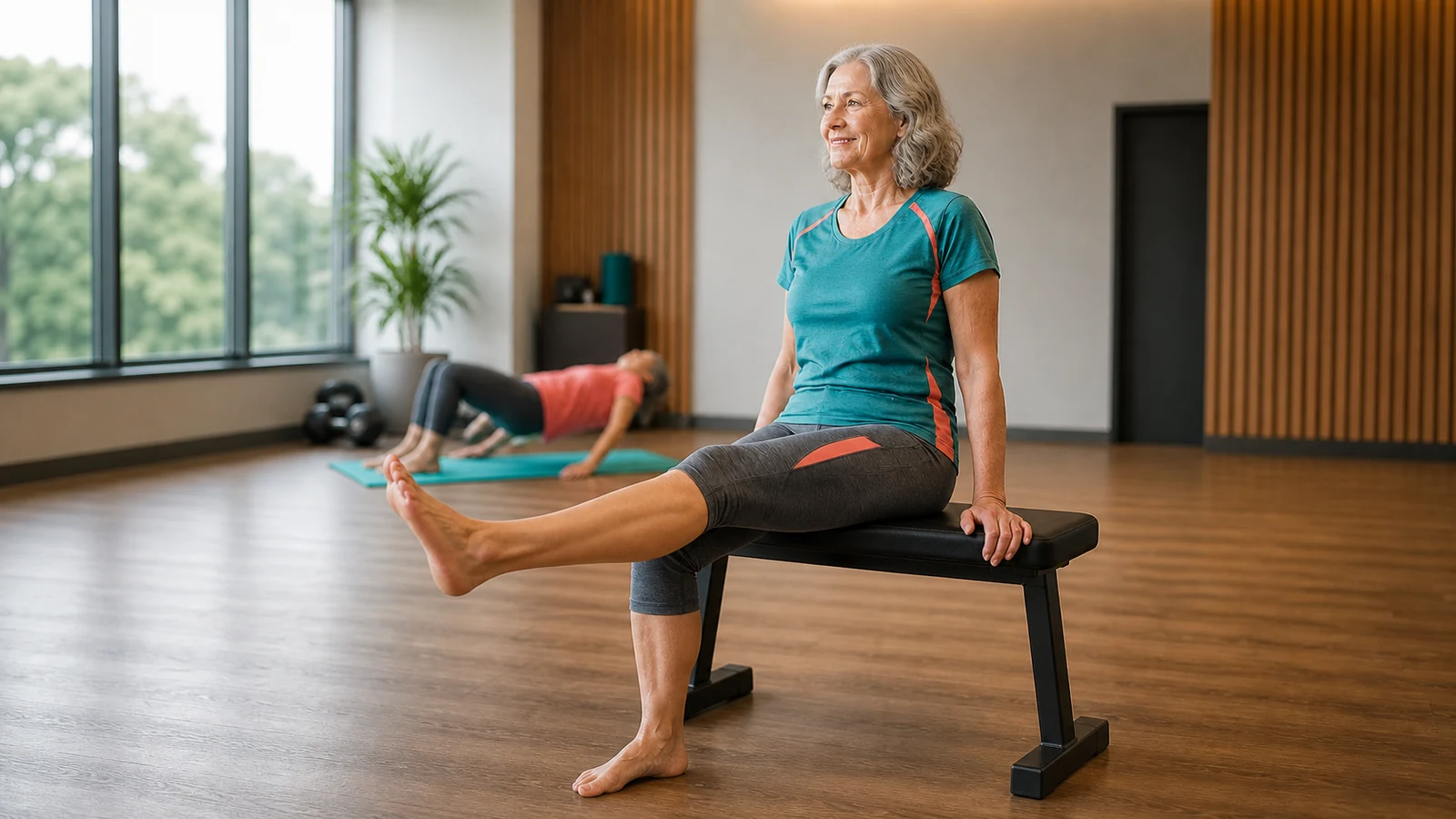
The featured studio scene is an editorial illustration, not a photograph of a treatment result or a technical demonstration of all three exercises below.
Bone on bone does not decide the entire exercise plan
In knee osteoarthritis, cartilage can wear away and the joint space can narrow substantially, allowing bones to rub against one another. AAOS explains that treatment depends on symptoms and individual circumstances, with physical therapy among the nonsurgical options.
The scan description should therefore be part of the conversation, alongside walking, stairs, sleep and the activities you want to regain. It does not supply a repetition count or establish that you must either stop all exercise or copy a demanding workout.
NICE recommends tailored therapeutic exercise for adults with osteoarthritis, including strengthening and aerobic fitness. When pain severity, disability or another condition makes participation difficult, specific advice and support, sometimes supervised exercise, may help.
Use your own rehabilitation restrictions after surgery or a recent injury. If severe symptoms are preventing ordinary activity, seek individual assessment rather than treating the published doses below as a target you must finish.
Symptoms that need assessment first
Under NHS knee-pain guidance, urgent advice is needed for a very painful knee, inability to move it or bear weight, major swelling, changed shape, locking or giving way. A hot or red knee with a high temperature or feeling feverish or shivery also needs urgent assessment.
Do not use an exercise session to test these symptoms. Arrange a clinical review if knee pain has not improved within a few weeks.
Three published knee-osteoarthritis exercise options
Northern Health and Social Care Trust publishes these OA strengthening options for three days per week.
| Exercise | How to do it | Published dose |
|---|---|---|
| Static quads | Sit or lie with the leg straight; reach the heel away, draw toes toward the shin and firmly tighten the front thigh. | Hold 5 to 10 seconds; 10 repetitions, three sets. |
| Seated knee extension | Sit with the back of the knee at the seat edge; reach the heel away, draw toes toward the shin and straighten the knee. | Hold 5 to 10 seconds; 10 repetitions, three sets. |
| Sit-to-stand | Move forward in the seat, feet and knees hip-width; bring feet underneath with heels down, lean forward, use arms if needed and stand. Lower slowly. | Initially 5 to 10 repetitions, three sets; rest 1 to 2 minutes between sets. |
For the first two, rest one minute between sets or work the opposite knee. Increase repetitions gradually as they become easier.
This guide selects options, not a tested three-move protocol for advanced arthritis. Compare the source exercise photographs with the instructions; our featured scene is illustrative.
Use the option that matches the actual task
Check the starting position and action in each row, rather than pick the exercise with the gentlest-sounding name. Matching the label alone is not enough to compare two versions of a movement.
A seated movement does not require a floor transfer, while a chair rise still requires standing and sitting safely. If getting into a position or completing the movement is itself difficult, request a demonstrated adaptation rather than improvise a new exercise and assume it has the same instructions.
Keep any individually prescribed dose beside the relevant exercise name. If it differs from the source table, record the actual instruction you were given instead of silently combining two programs.
Monitor the exercise and its aftereffect
NHS inform’s knee-OA exercise guide uses a 0 to 10 pain scale, aiming to keep exercise pain within 0 to 5. Its adjustments for excessive pain include fewer repetitions, slower movement or more rest.
It also says exercise should not make existing knee pain worse overall or worse the next morning, and advises stopping movements that worsen symptoms or cause new pain. A generic pain number is not personal clearance after an injury or a substitute for condition-specific restrictions.
These symptom checks are separate from the Trust’s dose table, and NHS inform publishes its own gradual starting and progression approach. Choose the plan that fits your clinical guidance rather than add its daily schedule on top of the three-day strengthening schedule above.
Write down both what happened during the movement and what happened afterward. “The repetitions were manageable, but I was limping on the next morning’s walk” gives the treating professional more useful information than a single rating taken mid-session.
When a response is outside the limits of your plan, reduce or stop as that plan directs and seek advice where needed. Completing all listed repetitions is not more important than a changed symptom pattern.
What the exercise studies actually support
A 2024 Cochrane review included 139 trials with 12,468 people with knee osteoarthritis. Exercise may improve pain and function, but evidence certainty was low to moderate and the clinical importance of average benefits remained uncertain.
The review pooled different exercise programs and participants, rather than testing this selected trio only in people with bone-on-bone knees. It supports a place for exercise in OA care, without predicting an individual’s result or proving that a particular home routine rebuilds cartilage.
| Evidence | What it describes | Limit for this guide |
|---|---|---|
| 2024 Cochrane review | Average effects across many knee-OA exercise programs. | It does not establish one best three-exercise prescription for every advanced knee. |
| 2015 Cochrane review | Earlier immediate pain and function estimates, described below. | Historical estimates are not the updated 2024 findings or proof of cartilage regeneration. |
| 2015 knee-replacement trial | Surgery plus nonsurgical care compared with a nonsurgical treatment package. | A package containing exercise is not a trial of these three movements alone. |
The 2015 Cochrane review included 54 studies overall. Its immediate pain and function analyses each drew on 44 trials, involving 3,537 and 3,913 participants respectively.
Average pain improved by 12 points on a 100-point scale (95% confidence interval 10 to 15), and function by 10 points (8 to 13). These historical averages were not limited to severe arthritis and do not prescribe three specific moves or demonstrate cartilage regrowth.
Read an outcome summary by asking who took part, what they were compared with and when the measurement occurred. A result after a program cannot be treated as the expected result of one short session.
Can exercise replace a knee-replacement decision?
In Skou and colleagues’ 2015 randomized trial, 100 surgery-eligible participants received either knee replacement plus nonsurgical care or nonsurgical care alone. The package included exercise, education, dietary advice, insoles and medicines, so its results cannot be credited to exercise alone.
Surgery produced greater improvement in the combined knee score at 12 months, alongside more serious adverse events. Some people assigned to nonsurgical care underwent replacement during follow-up, illustrating a treatment tradeoff rather than proof that a few movements reliably avoid surgery.
AAOS describes considering surgery when pain and disability have not been relieved by nonsurgical treatment. Exercise, symptom management and a surgical consultation can therefore belong in the same care discussion, rather than require a promise that one makes the others unnecessary.
Keep a session record that explains the exercise
Use this simple record to keep instructions, actual work and daily function together. It is a way to describe your experience, not a diagnostic test or an invented progression formula.
- Starting context: Known diagnosis, current restrictions and any recent symptom change.
- Exact exercise: Static quads, seated knee extension or chair rise, including the position used.
- Plan and actual work: Prescribed holds, repetitions, sets and rest, followed by what you completed.
- Session response: Symptoms during and after the movement, plus any change in walking.
- Following morning: Whether usual symptoms and ordinary activity were better, similar or worse.
- Next decision: Follow the existing plan, use its adjustment rule or ask for reassessment.
For a chair-rise record, note whether you used your arms and which chair you used. A change in those conditions matters when comparing one session with another; a higher repetition count alone does not describe the whole task.
Choose an everyday goal to discuss, such as managing a familiar walk or getting up from your usual chair. Bone-on-bone knee exercises are most useful when the movement, dose and symptom response remain connected to that goal and to your actual care plan.
Sources and exercise references
- Northern Trust: OA exercise instructions and doses, linked beside the table.
- NICE, AAOS, NHS and NHS inform: tailored exercise, symptom monitoring and medical-attention guidance, linked beside the relevant advice.
- Lawford and colleagues, 2024: updated Cochrane exercise review.
- Fransen and colleagues, 2015: earlier Cochrane exercise review.
- Skou and colleagues, 2015: randomized comparison of knee replacement and nonsurgical care.
Medical disclaimer: This article is general fitness information, not medical advice. If you have an injury, ongoing pain or a medical condition, talk to a doctor or physical therapist before changing how you train.