

Zone 2 cardio has become the most fashionable training idea of the last few years.
Podcasts, coaches, and short videos all push the same message, which is that you should spend hours a week at a conversational pace.
Some of that message is sound, and the easy end of the intensity scale genuinely belongs in a training week.
The problem is the gap between how confident the claims sound and how thin the specific evidence is.
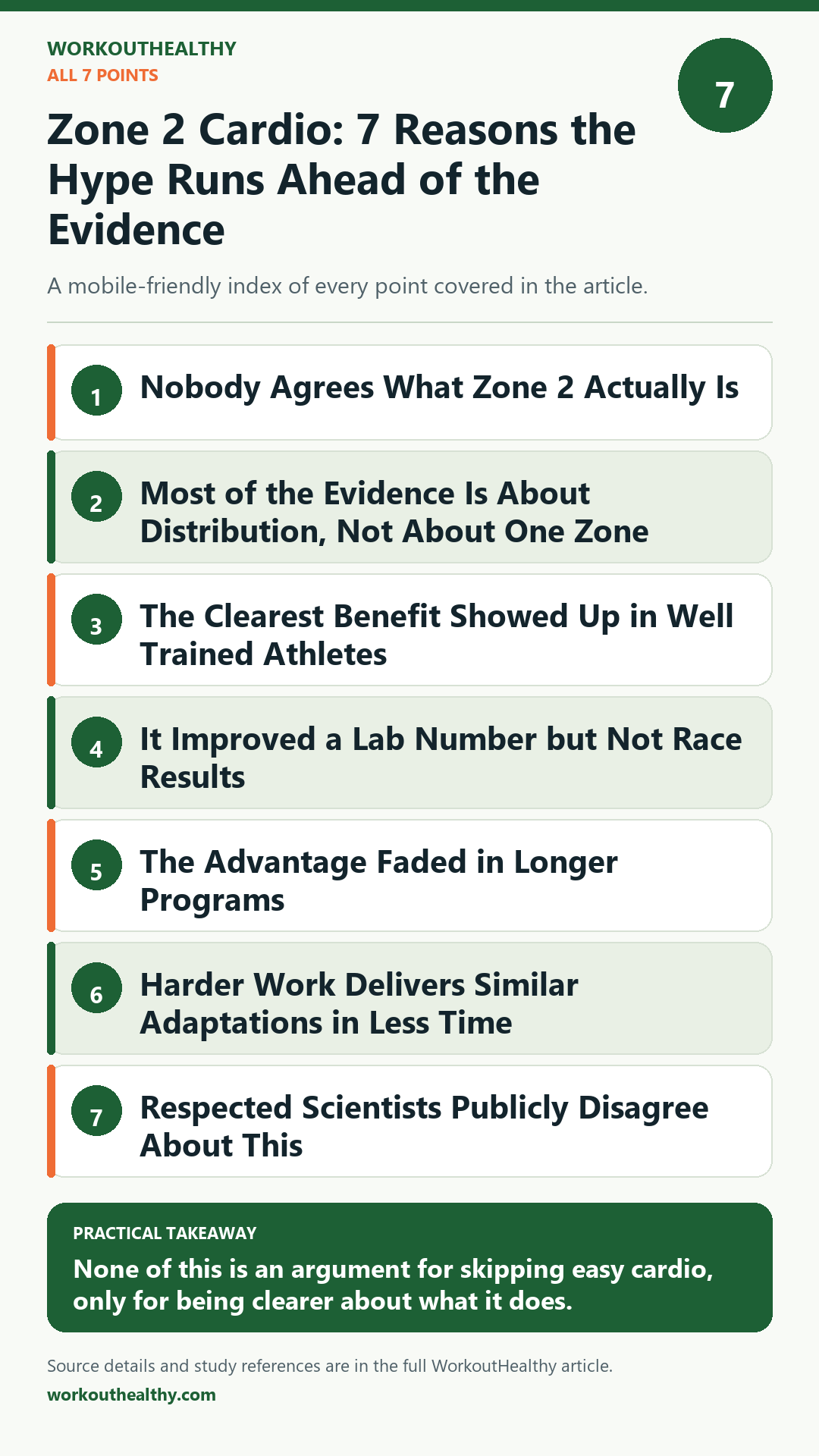
Here are seven honest reasons the zone 2 trend is oversold, followed by a straight answer about who it actually helps.
None of this is an argument for skipping easy cardio, only for being clearer about what it does.
1. Nobody Agrees What Zone 2 Actually Is
This is the first crack and it runs through everything else.
Some coaches define the easy zone by percentage of maximum heart rate, others by percentage of heart rate reserve, and others by blood lactate readings.
A three zone model and a five zone model put the boundaries in different places, so the same ride can be two different zones depending on whose chart you use.
Lactate testing is the most precise method and almost nobody following this trend has had it done.
A finger prick lactate test in a lab is what the original coaching definition relied on.
When a term means five slightly different things, claims about it are hard to check.
Two people can both say they trained in zone 2 and have worked at genuinely different intensities.
That alone should make you cautious about precise sounding claims.
2. Most of the Evidence Is About Distribution, Not About One Zone
The research people cite for easy cardio is usually research on polarized training.
Polarized training means doing most of your sessions easy and a small slice very hard, with little in the middle.
That is a claim about how a whole week is arranged, not a claim that one intensity band has special properties.
Borrowing the evidence for a distribution and applying it to a single zone is a real logical stretch.
The easy work in those studies only exists alongside the hard work, and the two were never tested separately.
Strip out the hard sessions and you no longer have the thing that was studied.
3. The Clearest Benefit Showed Up in Well Trained Athletes

Oliveira, Boppre, and Fonseca pooled 17 studies covering 437 participants comparing polarized training against other intensity arrangements.
Polarized training did improve peak oxygen uptake, with a small effect size of 0.24.
When they split the results by training status, the benefit was clearest in highly trained and national level athletes, with an effect size of 0.46.
Effects were less pronounced in less trained populations.
That is close to the opposite of how the trend is marketed, which is as a beginner friendly shortcut.
An effect size of 0.24 is also small, which means the average difference between groups was modest.
The uncomfortable summary is that the training approach recommended most loudly to beginners has its strongest evidence in national level athletes.
4. It Improved a Lab Number but Not Race Results
This is the finding that should temper the enthusiasm most.
In that same analysis, polarized training showed no significant advantage in time trials, with an effect size of essentially zero.
It also showed no advantage for time to exhaustion or for threshold velocity and power.
So the approach moved a laboratory measure of aerobic power while leaving the actual performance measures roughly unchanged.
The authors concluded that polarized training improved aerobic power but proved equivalent to other methods for aerobic capacity development.
5. The Advantage Faded in Longer Programs
Short term results are easy to oversell, and this is a clean example.
The superiority for peak oxygen uptake appeared only in interventions shorter than 12 weeks.
In programs of 12 weeks or longer, no advantage was observed.
A benefit that disappears once you train for three months is not the foundation for a lifelong training philosophy.
It may simply reflect a novel stimulus producing an early response.
Almost any change in how you train produces something in the first two months.
6. Harder Work Delivers Similar Adaptations in Less Time
The mitochondrial and aerobic adaptations attributed to slow cardio are not unique to slow cardio.
MacInnis and Gibala reviewed the physiology of interval training and the role of exercise intensity and described how higher intensity work drives many of the same adaptations.
Intensity and volume can both get you there, which means the total work you do matters more than the specific pace.
For a person with four hours a week rather than fourteen, that is a significant practical point.
Very long easy sessions are a luxury of people whose job is training.
If your weekly hours are limited, spending all of them at an easy pace is a real trade off rather than a free upgrade.
7. Respected Scientists Publicly Disagree About This
You would not know it from social media, but this is a live argument in the literature.
Burnley, Bearden, and Jones published a paper in Medicine and Science in Sports and Exercise arguing directly that polarized training is not optimal for endurance athletes.
Other researchers published rebuttals in the same issue defending the approach.
Genuine scientific disagreement is healthy, but it is not what a confident video implies.
When the experts are still arguing, certainty from an influencer is a warning sign.
It is worth noting that the video linked below actually argues in favor of zone 2 for everyday riders, which is a reasonable position too.
What This Evidence Does Not Prove
None of this means easy cardio is useless, and that reading would be wrong.
Easy aerobic work is low stress, easy to recover from, sustainable for decades, and pleasant enough that people keep doing it.
Those are real advantages that no effect size captures.
The Oliveira analysis covered 437 participants in total, which is modest, and it studied athletes rather than general population adults.
Its subgroup findings by training status and program length are exploratory, which makes them weaker than the main result.
No study in this area directly tested an easy only program against a mixed intensity program in ordinary people over a year.
And the lactate based definition that serious coaches use has barely been tested in recreational exercisers at all.
So the fair verdict is that this approach is unproven for most people who are doing it, not that it is harmful.
Overhyped and useless are two very different accusations, and only the first one fits here.
Who This Actually Benefits Most, and How to Use It
The honest answer from the research is that well trained endurance athletes doing high weekly volume have the clearest case for it.
If you are training ten or more hours a week, keeping most of that easy is what lets you absorb the hard sessions.
People returning from injury or illness also benefit, because low intensity work rebuilds a base without much recovery cost.
Older adults and anyone managing a health condition often find easy cardio the most sustainable entry point.
For everyone else, the practical version is simple: get most of your weekly minutes at an easy conversational pace, and add one or two harder sessions.
Walking counts toward this, and the evidence behind daily step counts and mortality is stronger than the evidence behind any specific heart rate zone.
If your time is limited, circuit training covers cardiovascular and strength goals in one session.
And if you lift as well as run, our piece on concurrent training interference explains how to arrange the week so the two do not fight each other.
Common Mistakes People Make With Easy Cardio
- Setting the zone from a generic 220 minus age formula, which is known to be a poor estimate for many individuals.
- Drifting above the intended pace on hills and calling the whole session easy.
- Replacing every hard session with easy work and losing top end fitness.
- Believing that fewer than three hours a week of easy work will produce athlete level results.
- Chasing a wrist based heart rate reading that lags and misreads during changing effort.
- Treating easy cardio as free, when it still adds fatigue and takes time away from strength work.
The first and the last mistakes cause the most frustration.
A pace where you can speak in full sentences is a better guide than an uncalibrated number on a watch.
If you can talk but would rather not sing, you are close enough for most purposes.
Who Should Talk to a Doctor Before Changing Cardio Intensity
Most people can safely adjust how hard they do their cardio.
Some should get advice before adding harder sessions.
Talk to a doctor first if you have known heart disease, an irregular heartbeat, or chest pressure during exertion.
The same applies to uncontrolled high blood pressure, a recent cardiac event, or a heart procedure in the past year.
Fainting, unexplained shortness of breath, or dizziness during light activity all deserve assessment rather than a harder program.
People taking beta blockers should know that heart rate zones do not mean what the charts say, so effort based pacing is usually better.
If you have diabetes, lung disease, or are pregnant, ask what intensity range is appropriate for you rather than following a general rule.
Watch the Original Video
Want the evidence behind the trend? Subscribe to WorkoutHealthy Insider for practical explanations behind popular fitness claims.
References
Burnley, M., Bearden, S. E., & Jones, A. M. (2022). Polarized training is not optimal for endurance athletes. Medicine & Science in Sports & Exercise, 54(6), 1032 to 1034. https://doi.org/10.1249/MSS.0000000000002869
MacInnis, M. J., & Gibala, M. J. (2017). Physiological adaptations to interval training and the role of exercise intensity. The Journal of Physiology, 595(9), 2915 to 2930. https://doi.org/10.1113/JP273196
Oliveira, P. S., Boppre, G., & Fonseca, H. (2024). Comparison of polarized versus other types of endurance training intensity distribution on athletes’ endurance performance: A systematic review with meta-analysis. Sports Medicine, 54(8), 2071 to 2095. https://doi.org/10.1007/s40279-024-02034-z
This article is for general information only and is not medical advice. If you have an injury, ongoing pain, or a medical condition, talk to a doctor or physical therapist before you change how you train or eat.