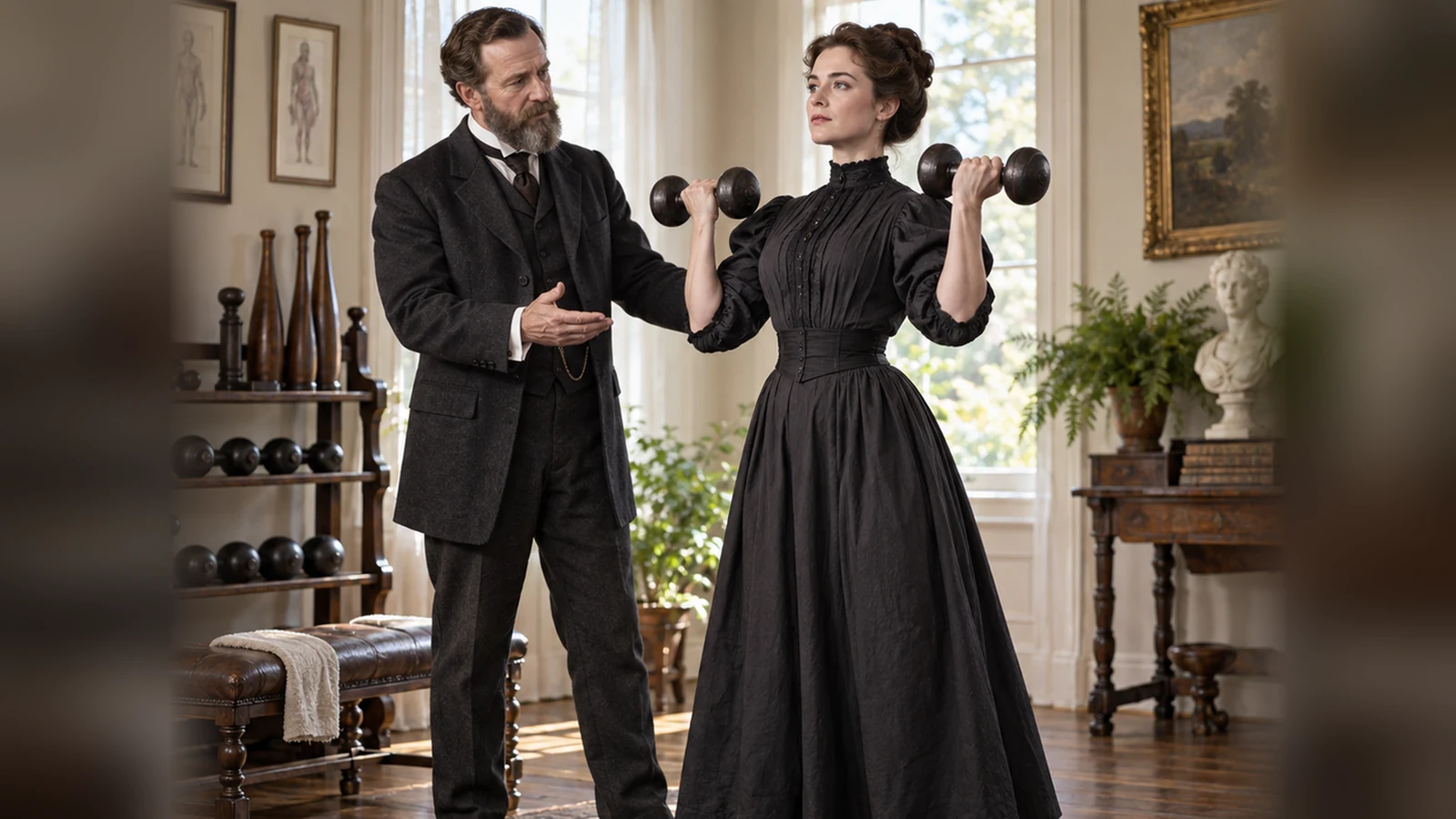

For much of the 1800s, many people assumed vigorous exercise would make a woman less feminine.
William Blaikie pushed back against the idea that women should avoid vigorous exercise. He devoted chapters of How to Get Strong and How to Stay So to girls and adult women, arguing that they could develop strength through gradual training.
He also linked exercise to grace and beauty, but that was his nineteenth-century opinion—not evidence that a training program makes anyone more attractive. His idea of “vigorous” had limits shaped by the gender expectations of his time.
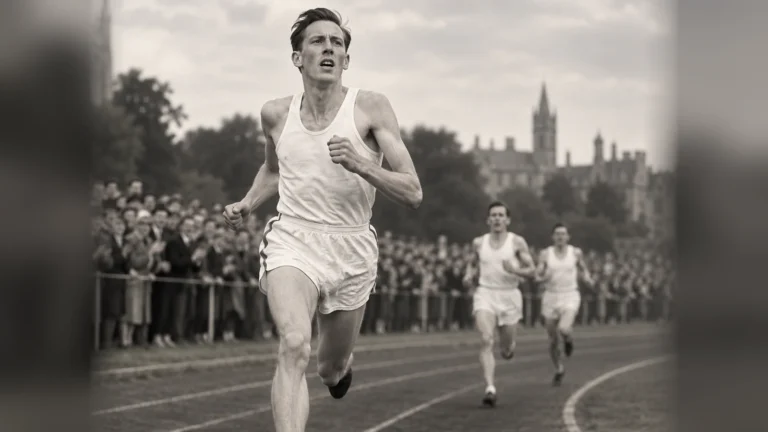
Visual note: the historical-style featured image is an AI editorial illustration, not an archival photograph of Blaikie.
The Worry Blaikie Was Answering
Blaikie lived from 1843 to 1904 and worked as a lawyer in New York City.
He was also a weightlifter and a long distance walker.
A New York newspaper, The Evening World, described him as one of the earliest and most vigorous advocates of physical culture in the country.
He wrote for ordinary readers, and he gave women and girls whole chapters of their own in his book.
Blaikie’s book, How to Get Strong and How to Stay So, first came out in 1879.
In the 1883 edition, a chapter called “Is It Too Late for Women to Begin?” raises the common fear directly.
He asks whether vigorous exercise, which produces hard and knotted muscles in men, might take away the softer and more graceful lines seen as feminine.
His answer starts with a yes, but only in one case.
If exercise went on for hours at a time, as a blacksmith’s work does, he agreed it would.
He then said a sensible system of exercise would avoid that, just as it would avoid weakness.
What Blaikie Actually Argued
His case was that regular, gradual training builds a different result than hard labor does.
He described “firmness and plumpness of muscle” that an unused arm or back had never had.
“Instead of these being incompatible with beauty, they are directly accessory to it.”
He quoted Ralph Waldo Emerson: “Elegance of form in the human figure marks some excellence of structure.”
He also pointed to famous beauties in paintings and statues, which he said showed firmness and symmetry, not leanness or flabbiness.
His method was simple.
Find the right amount of work for each person, keep it up daily, and add more as strength grows.
He said a little trial soon shows how much work suits each pupil.
Grace Was About Movement, Too
In a chapter on girls, Blaikie complained that few of their games gave them really vigorous exercise.
He wrote that hardly one girl in a group had the “swift, graceful, gliding motion” she could easily learn by running.
He added that most of their vigorous play used the feet alone, with the hands seldom doing much.
For Blaikie, graceful running was a skill he believed girls could practice. His book records that belief; it does not establish a measured effect of strength training on grace.
Where His View Shows Its Age
Blaikie still described hardness and solidity of muscle as “essentially masculine.”
He also judged women’s exercise partly by how it affected their looks.
Modern coaches would put health, strength, and ability first.
Even so, his core message told women to train with real vigor, daily and progressively.
What the Original Book Can Actually Establish
Blaikie’s book is primary evidence for what he argued in the 1880s. It is not a controlled trial showing that exercise makes anyone more graceful, attractive, healthy, or safe from disease. He drew on observations of schoolgirls, workers, and art, then interpreted those observations through the beauty standards of his era. Those examples explain his reasoning, but they do not measure the effects of a training program.
That distinction matters because the viral claim can sound like a modern scientific finding. The documented historical fact is narrower: Blaikie explicitly rejected the idea that sensible, progressive exercise had to make women less feminine. His statements about appearance were opinions. His wider advocacy for women’s physical capacity was notable, but it still came wrapped in gender rules that readers do not need to adopt.
He also discussed adult women who worked long hours at repetitive tasks and argued that unused muscles deserved deliberate training. That observation may feel familiar to someone who sits at a desk or repeats the same movements all day. It does not mean every weakness or pain is caused by inactivity. An individual problem can have many causes, and exercise should be adapted to the person rather than copied from a nineteenth-century prescription.
What Gradual Progression Means in Practice
The most durable part of Blaikie’s advice is the sequence: start with an amount you can manage, repeat it, and increase the challenge when you are ready. It is a principle, not a requirement to train hard every day. Recovery, other activity, health conditions, and experience all affect how much work is useful. A modern reader should not assume that his daily schedule or his idea of a suitable woman’s physique is the right target.
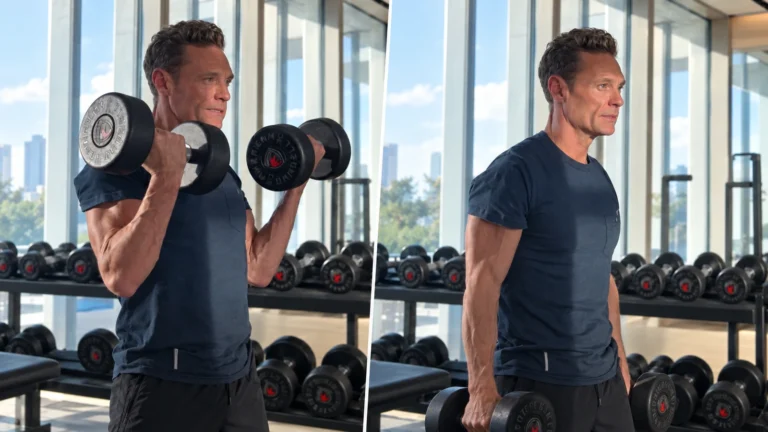
For someone new to resistance training, a fair test is to choose a few movements that cover the legs, a push, and a pull, then record the load, repetitions, and how the movements feel. On later sessions, compare like with like. If technique remains controlled and the planned work becomes comfortable, progress one variable at a time: a little more resistance, another repetition, or an additional set. If form deteriorates or soreness disrupts the next session, the answer may be to hold steady or reduce the dose.
This approach makes the outcome measurable without turning appearance into a verdict. Carrying groceries more easily, doing more controlled repetitions, or feeling steadier in a chosen activity are concrete signs of useful training. Blaikie’s language of grace and beauty belongs to his historical setting; the decision about what strength is for belongs to the person doing the work.
What Modern Research Shows
The old fear was that women would respond to training in some unwanted way.
Research points in a different direction. Women adapt to strength training much like men do.
A 2020 meta-analysis by Brandon Roberts, Greg Nuckols, and James Krieger compared the sexes directly.
Males and females had similar effect sizes for muscle growth and lower body strength.
Females had a larger effect for relative upper body strength.
A 2025 Bayesian meta-analysis led by Martin Refalo pooled 29 studies.
Men gained slightly more muscle in absolute terms, mostly in the upper body.
Relative gains in muscle size, compared with each person’s starting point, were similar between the sexes.
The authors concluded that women have a similar potential for muscle growth as men.
For a closer look at programming, see our article on whether men and women need different workouts.
What the Research Does Not Settle
The 2025 analysis mostly included young adults, with an average age of about 26 years.
Results may differ for older women, teens, or highly trained athletes.
The analysis also found absolute upper body size gains favored men, so the picture is not identical everywhere.
The Roberts team also said it is unclear why women gained more relative upper body strength.
Possible reasons include nerve and muscle changes, learning the lifts, or how the studies were designed.
And none of this research measured grace or beauty, which were Blaikie’s main concerns.
How to Apply It Today
- Lift for strength, not just toning. Use loads that make the last few reps of a set feel hard.
- Train the upper body, too. Blaikie noticed girls rarely used their hands and arms in play, and many adults still skip them.
- Add weight gradually. His advice to increase work as strength justifies it is still sound.
- Include running or brisk movement. He tied grace to confident, practiced motion.
- Keep training through midlife. Our look at why protein alone cannot stop muscle loss after menopause explains why strength work matters then.
For proof of what trained women can do, read about Lucy Underdown’s 325 kilogram deadlift record.
Common Mistakes
- Fearing bulk from light training. Muscle gain takes consistent, hard work over months.
- Using weights that are too light to matter. Endless easy reps rarely build much strength.
- Judging progress only by the mirror. Track lifts, reps, and how daily tasks feel.
Who Should Be Careful
Women who are pregnant, recently postpartum, or managing pelvic floor symptoms should get tailored advice before heavy lifting.
The same goes for anyone with osteoporosis, joint pain, or a past injury.
The Bottom Line
William Blaikie argued that girls and women should train for strength, and he believed sensible exercise could be compatible with the beauty standards of his time. The book does not prove that exercise makes women more graceful or attractive.
His advocacy for women’s physical capacity remains historically interesting, while his appearance-based judgments and gender limits belong to the nineteenth century.
Modern research shows women gain strength and muscle in proportion much like men.
Train with purpose, build up gradually, and let real strength be the main goal.
Want more stories like this? Subscribe to WorkoutHealthy Insider for practical explanations behind popular fitness claims.
References
- Blaikie, W. (1883). How to get strong and how to stay so. Harper & Brothers. (Original work published 1879). https://www.gutenberg.org/ebooks/36557
- Refalo, M. C., Nuckols, G., Galpin, A. J., Gallagher, I. J., Hamilton, D. L., & Fyfe, J. J. (2025). Sex differences in absolute and relative changes in muscle size following resistance training in healthy adults: A systematic review with Bayesian meta-analysis. PeerJ, 13, e19042. https://doi.org/10.7717/peerj.19042
- Roberts, B. M., Nuckols, G., & Krieger, J. W. (2020). Sex differences in resistance training: A systematic review and meta-analysis. Journal of Strength and Conditioning Research, 34(5), 1448 to 1460. https://doi.org/10.1519/JSC.0000000000003521
- Wikipedia contributors. (n.d.). William Blaikie. In Wikipedia. Retrieved September 16, 2026, from https://en.wikipedia.org/wiki/William_Blaikie
This article is for general information only and is not medical advice. If you have an injury, ongoing pain, or a medical condition, talk to a doctor or physical therapist before you change how you train or eat.