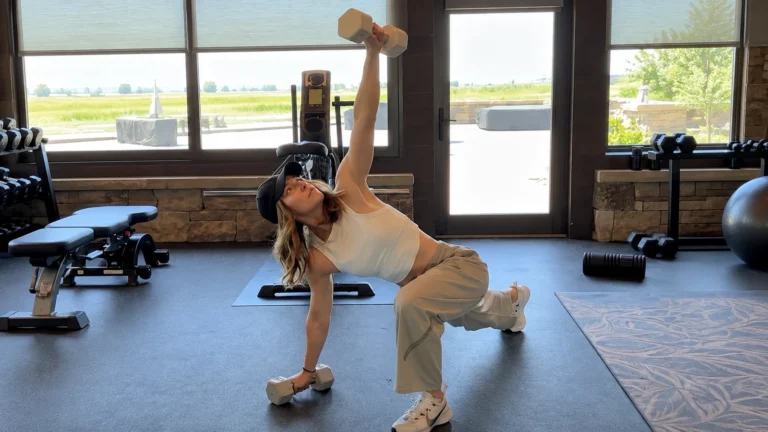

A YouTube video claims to show safe strength exercises for week two of breast cancer recovery.
The video says these moves are appropriate once a surgeon has cleared the patient to move.
Breast cancer surgery recovery is not something a video can standardize.
Every surgery is different.
Every body heals at its own pace.
This article does not walk through the video’s specific week two routine.
Instead, it looks at what real, peer reviewed research says about exercise after breast cancer surgery.
It explains why the timing and choice of exercise has to come from your own surgical team.
What the Video Claims
The video comes from a channel called Outside the Doc Box.
The channel describes itself as run by two healthcare professionals.
One is identified as an emergency physician who is also a breast cancer survivor.
The other is identified as an occupational therapist and certified lymphedema therapist.
Those are the credentials the channel states about itself.
This article did not independently verify a medical license or certification number for either person.
An emergency medicine background is not the same as a specialty in surgical oncology or breast cancer rehabilitation.
An occupational therapist with lymphedema certification does have training directly relevant to this topic.
Even so, no video can know your specific surgery.
It cannot know how many lymph nodes were removed.
It cannot know how your incision is healing right now.
It cannot know what your own surgeon wants for your specific timeline.
That is why this article will not repeat the video’s numbered week two exercises as a routine to copy.
Instead, it looks at the actual research behind exercise timing and safety after breast cancer surgery.
What Real Research Shows About Shoulder Mobility and Movement Timing
Shoulder stiffness is one of the most common problems after breast cancer surgery.
This is especially true when lymph nodes are removed from under the arm.
Researchers have studied how soon physical therapy should safely start after this kind of surgery.
Lauridsen and colleagues randomly assigned women to a supervised physiotherapy program or to standard information alone after breast cancer surgery.
The physiotherapy group ended up with better shoulder range of motion and fewer symptoms (Lauridsen et al., 2005).
A separate randomized trial by Beurskens and colleagues compared three months of physiotherapy with a leaflet of advice and exercises after axillary dissection.
At three and six months, the physiotherapy group had better shoulder mobility and less pain. This was not a trial of starting therapy immediately versus weeks later (Beurskens et al., 2007).
But timing research does not all point in one direction.
Bendz and Fagevik Olsen compared an early physiotherapist-supervised program with written advice followed by the same exercise program for both groups at two weeks.
The early-program group recovered shoulder mobility sooner; the published abstract did not report a seroma comparison, so this trial should not be cited as proving that delaying exercise reduced fluid buildup (Bendz & Fagevik Olsen, 2002).
These trials do not agree on one single best starting day.
That is exactly why a “week two” framing in a viral video should not be treated as a universal rule.
The real research shows timing depends on the surgery, the person, and close monitoring by a clinical team.
Research does not support the old advice to avoid all lifting after lymph node surgery. Supervised, gradually progressed exercise appears safe for most women, and it does not raise lymphedema risk the way many patients were once told.
What Real Research Shows About Lymphedema Risk and Supervised Exercise
Lymphedema is a major fear after breast cancer surgery, especially when lymph nodes are removed.
It causes swelling in the arm or hand on the surgery side.
For years, many patients were told to avoid lifting anything heavy to protect against it.
Research since then has changed that advice.
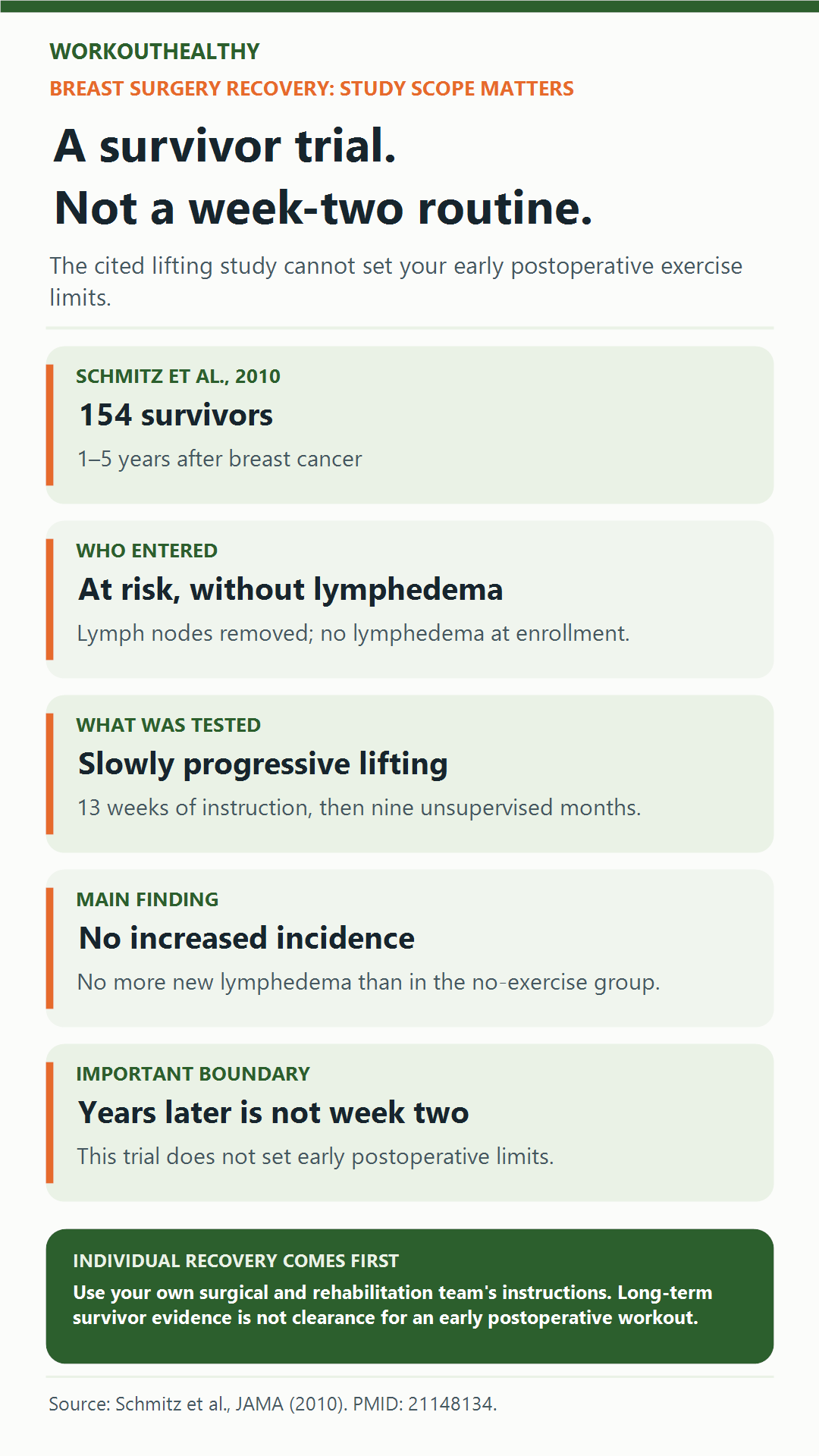
Schmitz and colleagues tested slowly progressive weight lifting in breast cancer survivors who were one to five years beyond diagnosis, had at least two lymph nodes removed, and did not have clinical lymphedema at entry.
Over one year, lymphedema onset was not higher in the weight-lifting group than in controls. Participants first received 13 weeks of supervised instruction, then continued unsupervised; this trial does not establish what is safe two weeks after surgery (Schmitz et al., 2010).
A larger systematic review by Cheema and colleagues looked across many trials of progressive resistance training in breast cancer patients and survivors.
It found that supervised resistance training was safe and did not raise lymphedema risk (Cheema et al., 2014).
A 2026 systematic review pooled several types of physical intervention, including compression, manual lymphatic drainage, and resistance training, rather than testing one week-two workout.
Its 12-month duration subgroup showed a statistical association with better lymphedema outcomes, while shorter-duration subgroups did not; those subgroup comparisons cannot prove that one year is required, that exercise alone caused the difference, or that a particular early postoperative routine is safe (Sun et al., 2026).
What Real Research Shows About Overall Recovery Benefits
Exercise after breast cancer surgery is not just about the shoulder or lymphedema risk.
McNeely and colleagues combined the results of many trials on exercise in breast cancer patients and survivors.
Their review found real improvements in quality of life, physical fitness, and physical functioning (McNeely et al., 2006).
They found no evidence that supervised exercise caused harm.
In 2019, a large international group of exercise and oncology experts published a consensus statement on exercise for cancer survivors.
The panel included researchers from major cancer centers and universities (Campbell et al., 2019).
They concluded that exercise is generally safe during and after cancer treatment, including breast cancer.
They specifically noted that resistance training does not need to be avoided out of fear of lymphedema.
Many interventions began with supervised instruction or used a structured clinical protocol, but some included substantial unsupervised follow-up.
None establishes that a generic online routine is appropriate for an individual patient in the second week after surgery.
The Mechanism
Why would exercise help after breast cancer surgery instead of causing harm?
Surgery and lymph node removal can scar and thicken tissue around the shoulder and chest.
Scar tissue can pull on the shoulder joint and limit how far the arm moves.
Gentle, progressive movement helps that tissue remodel in a more flexible pattern.
This is similar to how physical therapy helps other kinds of surgical scarring regain motion.
The lymphedema mechanism works differently.
Lymph nodes act like drainage stations for fluid in the arm.
When nodes are removed, fewer drainage routes remain.
Muscle contraction from movement, especially rhythmic movement like walking or controlled lifting, helps push lymph fluid through the remaining pathways.
That is one proposed reason gradual, monitored exercise does not raise lymphedema risk the way early guidance feared.
There is also a broader reconditioning effect.
Cancer treatment, including surgery, chemotherapy, and radiation, can cause real muscle loss and fatigue.
Muscle loss during any major medical treatment is a real concern, not something unique to cancer, as we cover in our look at losing weight and muscle mass during illness or major life change.
Structured exercise, reintroduced at the right pace, helps rebuild strength and stamina lost during treatment.
It can also support mental health during a genuinely stressful period.
None of these mechanisms mean any specific routine is right for any specific person.
Watch the video
What This Evidence Does Not Prove
This research does not prove that one single week by week timeline applies to everyone.
Studies used different surgeries, different numbers of lymph nodes removed, and different starting points for exercise.
Some trials started supervised movement within days of surgery.
Others waited a week or more.
The trials do not agree on one exact starting day, which means a video cannot responsibly claim one either.
This research also does not prove that unsupervised exercise from a video is as safe as the supervised programs in these trials.
Several trials included professional instruction or monitoring, while at least one weight-lifting trial also included months of unsupervised continuation after an initial supervised phase.
None of them handed a participant a video and let them decide alone.
The 2026 review’s duration subgroups cannot determine the right starting day or duration for an individual patient, especially because intervention types and patient risks differed.
Finally, this research is about breast cancer surgery broadly.
It does not account for a reader’s specific surgery type, reconstruction, radiation history, or overall health.
Only your own surgical and rehabilitation team has that full picture.
Who Should Work With a Clinical Team
This entire topic calls for individualized medical guidance, not general fitness advice.
Anyone recovering from breast cancer surgery should have a plan built with their surgeon and, ideally, a physical or occupational therapist.
That is true whether the surgery was a lumpectomy or a mastectomy.
It is true whether or not lymph nodes were removed.
A clinical team can check your incision, drains, and healing before clearing any movement.
They can watch for early signs of seroma, infection, or wound problems that a video simply cannot see.
They can measure your actual shoulder range of motion instead of guessing from a screen.
A certified lymphedema therapist, like one of the presenters in the source video describes herself to be, is trained to design a program around your specific lymph node surgery.
That kind of one on one assessment is not possible through a YouTube video, no matter who is presenting it.
If your surgeon has cleared you for movement, the next right step is asking them, or a referred physical therapist, what is appropriate for your specific case.
A structured, professionally guided recovery after major medical treatment is possible and often very effective, a pattern also visible in a very different context in our look at Misty Copeland’s hip replacement recovery.
The common thread in every real recovery story is professional guidance, not a generic routine copied from a video.
No study behind these findings tested this online week-two workout. The trial populations, surgery types, and level of professional guidance varied, so a personal clearance decision still belongs with the treating team.
Who Should Be Extra Careful
Some situations call for even more caution than a typical recovery.
Anyone who had immediate breast reconstruction along with their cancer surgery has extra tissue and healing considerations.
Anyone who will also have radiation therapy needs a plan that accounts for how radiation affects healing tissue over time.
Anyone with drains still in place should not start upper body exercise without their surgical team’s clearance.
Anyone with signs of infection, unusual swelling, fever, or a wound that is not healing normally should contact their care team before exercise, not after.
Anyone who already has lymphedema needs a program built specifically around that diagnosis, ideally with a certified lymphedema therapist.
Anyone with other health conditions from before their cancer diagnosis needs a plan that accounts for those conditions too.
In short, almost everyone reading this falls into some category that needs individualized guidance.
That is the nature of this specific topic.
It is not a general fitness question with one universal answer.
A Practical Takeaway
The most useful thing this research offers is not a workout to copy.
It is a set of questions worth asking your own surgical and rehabilitation team.

Ask when it is safe to begin gentle shoulder movement after your specific surgery.
Ask whether you are a candidate for supervised physical or occupational therapy, and how to get a referral.
Ask what signs would mean you should stop an exercise and call your team.
Ask how your specific lymph node surgery affects your lymphedema risk and prevention plan.
General population exercise guidance, like recommendations on how many miles to walk in a day, does not automatically apply during early surgical recovery.
It may become relevant later, once your team clears you for general activity.
Resistance training in general has documented benefits beyond muscle and strength, including for the nervous system, as we cover in our look at whether lifting weights keeps your brain young.
That broader research is about a different population under different circumstances.
The research summarized in this article should shape the questions you bring to your care team.
It should never replace their judgment.
Want more like this? Subscribe to WorkoutHealthy Insider for practical explanations behind popular fitness claims.
References
Bendz, I., & Fagevik Olsén, M. (2002). Evaluation of immediate versus delayed shoulder exercises after breast cancer surgery including lymph node dissection: A randomised controlled trial. The Breast, 11(3), 241 to 248. https://doi.org/10.1054/brst.2001.0412
Beurskens, C. H. G., van Uden, C. J. T., Strobbe, L. J. A., Oostendorp, R. A. B., & Wobbes, T. (2007). The efficacy of physiotherapy upon shoulder function following axillary dissection in breast cancer, a randomized controlled study. BMC Cancer, 7, 166. https://doi.org/10.1186/1471-2407-7-166
Campbell, K. L., Winters-Stone, K. M., Wiskemann, J., May, A. M., Schwartz, A. L., Courneya, K. S., Zucker, D. S., Matthews, C. E., Ligibel, J. A., Gerber, L. H., Morris, G. S., Patel, A. V., Hue, T. F., Perna, F. M., & Schmitz, K. H. (2019). Exercise guidelines for cancer survivors: Consensus statement from International Multidisciplinary Roundtable. Medicine & Science in Sports & Exercise, 51(11), 2375 to 2390. https://doi.org/10.1249/MSS.0000000000002116
Cheema, B. S., Kilbreath, S. L., Fahey, P. P., Delaney, G. P., & Atlantis, E. (2014). Safety and efficacy of progressive resistance training in breast cancer: A systematic review and meta-analysis. Breast Cancer Research and Treatment, 148(2), 249 to 268. https://doi.org/10.1007/s10549-014-3162-9
Lauridsen, M. C., Christiansen, P., & Hessov, I. (2005). The effect of physiotherapy on shoulder function in patients surgically treated for breast cancer: A randomized study. Acta Oncologica, 44(5), 449 to 457. https://doi.org/10.1080/02841860510029905
McNeely, M. L., Campbell, K. L., Rowe, B. H., Klassen, T. P., Mackey, J. R., & Courneya, K. S. (2006). Effects of exercise on breast cancer patients and survivors: A systematic review and meta-analysis. CMAJ, 175(1), 34 to 41. https://doi.org/10.1503/cmaj.051073
Schmitz, K. H., Ahmed, R. L., Troxel, A. B., Cheville, A., Lewis-Grant, L., Smith, R., Bryan, C. J., Williams-Smith, C. T., & Chittams, J. (2010). Weight lifting for women at risk for breast cancer-related lymphedema: A randomized trial. JAMA, 304(24), 2699 to 2705. https://doi.org/10.1001/jama.2010.1837
Sun, X., Wei, Y., Zhang, X., Zhuang, X., & Zhang, Y. (2026). Efficacy of physical therapy for prevention and treatment of postoperative lymphedema in breast cancer: A systematic review and meta-analysis. Frontiers in Oncology, 16, Article 1760801. https://doi.org/10.3389/fonc.2026.1760801
This article is for general information only and is not medical advice. If you have an injury, ongoing pain, or a medical condition, talk to a doctor or physical therapist before you change how you train or eat.